Best College Towns in America 2026: What the Rankings Actually Tell You
Here's a tension nobody quite resolves: Austin, Texas has claimed the top spot in WalletHub's college city rankings for four straight years. But Bozeman, Montana — a city of about 53,000 people where a studio apartment runs upward of $1,920 a month — has held the number one position in RentCafe's college town study for three consecutive years. Same country, same question, wildly different answers. That gap isn't a mistake. It's a window into what college town rankings actually measure, and why the answer to "where should I go?" depends entirely on what you're optimizing for.
Why Two Major Rankings Come to Opposite Conclusions
Rankings diverge because they measure different things. WalletHub compared 415 U.S. cities across 31 key indicators spanning affordability, social environment, and post-graduation economic opportunity. With a pool that large, big cities dominate. Austin, Atlanta, Orlando, and Tampa fill the top ten because they offer nightlife, job markets, and population density that small towns simply cannot match.
RentCafe took a different approach. They focused on college-centric communities where the university is the town's heartbeat, not an afterthought. And in their most recent methodology overhaul, they eliminated traditional reputation scores entirely, replacing them with student retention rates — the logic being that students who stay are students who are genuinely happy, not students who were sold a brochure.
Both approaches are valid. One tells you where a college graduate might thrive. The other tells you where a college student actually wants to be.
"Retention rates are a much clearer indicator of whether students are genuinely happy where they are or not." — RentCafe 2026 methodology notes
The 2026 Top College Towns at a Glance
Below are the top picks from both major 2026 rankings, alongside a HomeSnacks composite that weighs safety, rent, and student population share.
| Rank | WalletHub (415 cities) | RentCafe (College-focused) | HomeSnacks (Composite) |
|---|---|---|---|
| 1 | Austin, TX | Bozeman, MT | Ann Arbor, MI |
| 2 | Ann Arbor, MI | Pullman, WA | Fairfax, VA |
| 3 | Orlando, FL | Clemson, SC | East Lansing, MI |
| 4 | Tampa, FL | Laramie, WY | Chapel Hill, NC |
| 5 | Raleigh, NC | Athens, OH (Top 10) | Laramie, WY |
| 6 | Tempe, AZ | Amherst, MA (NE leader) | Bloomington, IN |
Ann Arbor is the one name that consistently appears near the top across every methodology. That's not a coincidence. With 348 out of every 1,000 residents being students, the city genuinely revolves around university life in a way that most large college cities don't. It's also home to the University of Michigan's massive research and athletic infrastructure, which shapes everything from local employment to game-day culture.
Why the West Is Winning Right Now
Half of RentCafe's top 10 for 2026 sit in western states, and the pattern is hard to ignore. Bozeman, Pullman, Laramie, and similar towns share something specific: proximity to mountains and open land within driving distance of campus. For students burning out between midterms and finals, the ability to hike or ski on a Saturday afternoon isn't a luxury amenity. It's a retention driver.
Gen Z, more than any previous student generation, reports that they want balance and space to decompress. That shift shows up directly in the data. Laramie, Wyoming jumped 12 positions in the 2026 RentCafe ranking — the single biggest climb in the top tier — partly because of its outdoor access and partly because Wyoming's low overall tax burden keeps local costs manageable.
Athens, Ohio made a similar leap, gaining five spots to crack the top 10. Ohio University's Appalachian foothills location gives it a natural-beauty edge that similar-sized Midwest towns simply don't have.
The West's dominance also points to something about air quality and pace. These aren't just marketing words. Students spending four years in a place with cleaner air, lower population density, and better walkability to green space show measurably higher satisfaction scores in retention data.
The Affordability Problem Nobody Talks About
Here's where some of the conventional wisdom falls apart. Bozeman's cost of living sits 30.5% above the national average, with housing running 48.2% more expensive than the U.S. baseline. In 2025, the median home price hovered near $700,000. That's a college town competing with San Francisco in terms of housing pressure.
The city lands at number one because its quality-of-life scores and retention metrics are genuinely exceptional. But for students who need off-campus housing flexibility, Bozeman has become a difficult place to be broke.
Austin has a mirror-image version of this problem. WalletHub put Austin first for the fourth year running, but the same report ranked it 186th out of 415 cities for financial accessibility. In-state tuition at the University of Texas with room and board runs roughly $31,433 per year. That's not prohibitive, but it's not cheap either.
The towns that thread the needle best are places like Laramie, WY and Morgantown, WV. Laramie's median rent sits around $929 a month. Morgantown checks in at $901. Both cities maintain low crime rates (Laramie ranks 9th nationally for safety among college towns in HomeSnacks data) while keeping the kind of cost profile where a part-time job actually covers rent.
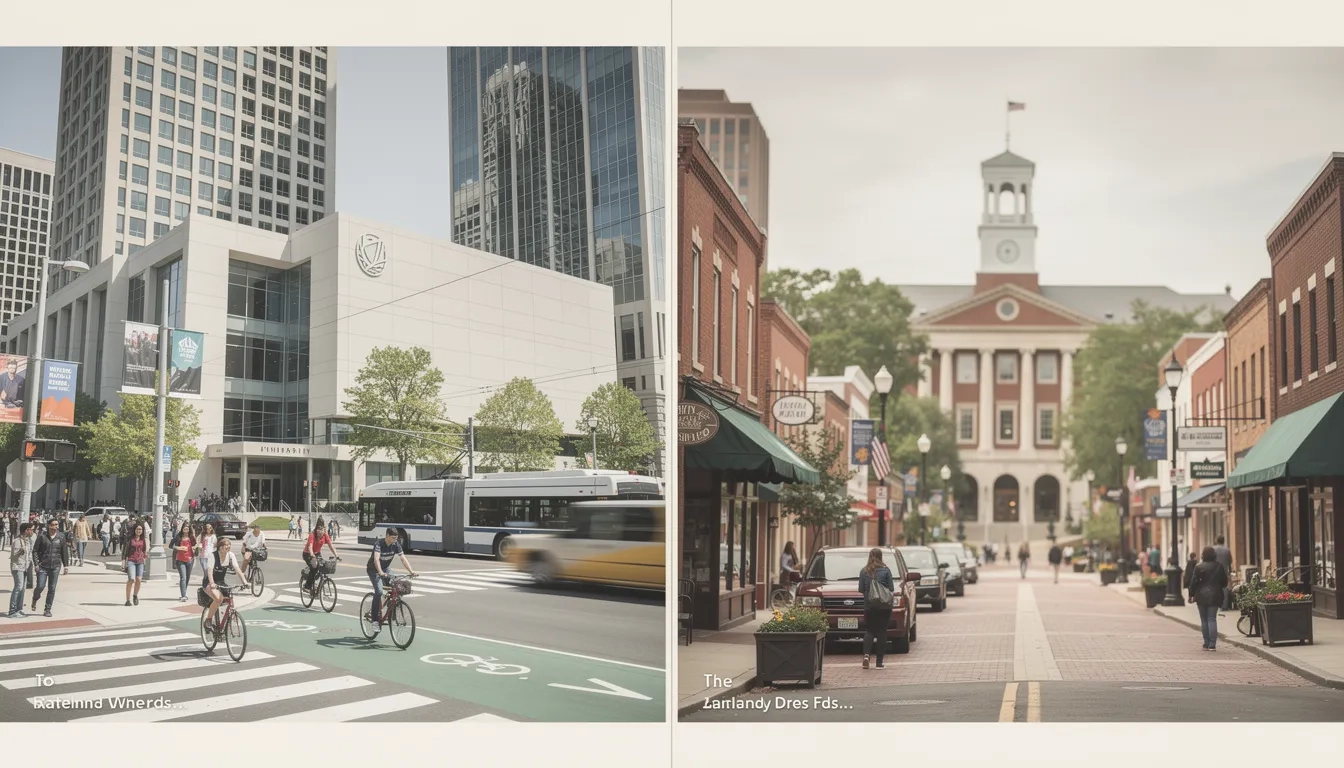
Big City vs. Small Town: Picking Your Side
This is the real decision most students face, and the rankings don't make it clearly enough. Here's how to think about it honestly.
Choose a large college city if:
- You want internship and job access while still in school
- You care about nightlife, restaurant variety, and cultural events
- You're okay paying more for housing in exchange for more options
- You plan to stay in the city after graduation
Choose a small college town if:
- You want the campus to be the social and cultural anchor
- You're looking for a tighter community where you'll actually know people
- Outdoor access matters to you more than urban amenities
- You want your rent to stay manageable on a student budget
Raleigh, NC and Tempe, AZ (WalletHub #5 and #6 respectively) represent an interesting middle ground. Both are mid-sized enough to have real job markets and enough going on culturally, but they still feel oriented around university life in a way that Orlando or Atlanta don't.
Charlottesville, Virginia (WalletHub #9) is another good example of this middle tier. The University of Virginia's presence shapes the city's personality, the downtown is walkable, and the Blue Ridge Mountains are close enough for weekend trips. It doesn't top any single category, but it avoids the worst trade-offs of both extremes.
Regional Standouts Worth Knowing
If you're narrowing by geography, here are the places that consistently earn strong marks within their regions.
Southeast:
- Clemson, SC climbed two spots to #3 on RentCafe's list and leads the South in that study. Gainesville, FL makes WalletHub's top 10 nationally and benefits from the University of Florida's size and the city's relatively affordable rents.
- Chapel Hill, NC earns consistently high marks across studies, with a median rent around $1,419 that's reasonable given its research university environment and proximity to Research Triangle Park employment.
Midwest:
- Ann Arbor, MI dominates. If you want the full college town experience with a nationally ranked research university, strong alumni networks, and Big Ten athletics, there's no better option in the region.
- East Lansing, MI (Michigan State) and Bloomington, IN (Indiana University) both offer genuine university-centered cultures with median rents well under $1,200 per month.
Northeast:
- Amherst, MA is the RentCafe regional leader and benefits from the Five College Consortium (UMass Amherst, Amherst College, Hampshire, Smith, and Mount Holyoke), which creates an unusually rich academic and social environment for a small town.
- Charlottesville, VA earns placement in WalletHub's national top 10 and consistently scores well for safety and quality of life among smaller eastern cities.
What Gen Z Is Actually Choosing For
The shift in what students value is showing up directly in the ranking data. Prestige still matters, but it no longer dominates. Students are increasingly choosing towns where they can sustain themselves without burning out, and the retention-rate methodology that RentCafe adopted for 2026 picks this up better than reputation-based scoring ever did.
What shows up in the data when you look at the towns climbing fastest: outdoor access, a walkable campus core, a genuine local community rather than just a transient student population, and a cost structure that doesn't force students into impossible financial stress.
The writing was on the wall for the large-city bias in older rankings. Big cities offer more, but they also impose more costs — financial and psychological. A student who spends four years in Morgantown or Laramie and genuinely thrives there will likely look back more fondly than one who white-knuckled through Austin's housing market.
My read on this: the RentCafe approach is actually more useful for undergraduates, while WalletHub's metrics lean toward what matters post-graduation. Use both together, and you get the full picture.
Bottom Line
- Ann Arbor, MI is the safest pick if you want near-universal agreement across ranking systems. Student density, academic reputation, and cultural infrastructure are all exceptional.
- Bozeman, MT and Laramie, WY are best for students who want outdoor access and genuine community, but go in with clear eyes about housing costs in Bozeman.
- Austin, TX is the right choice if post-graduation employment and urban life matter more than affordability during school.
- For the best value, look at Morgantown, WV, Bloomington, IN, and Champaign, IL — genuine college towns where $900 to $1,100 a month in rent is still realistic.
- Before committing to any town, check the school's retention and four-year graduation rates. They are more honest signals of student satisfaction than any ranking score.
Frequently Asked Questions
What's the difference between WalletHub and RentCafe college town rankings?
WalletHub compares 415 U.S. cities of all sizes using 31 metrics weighted toward social life, economic opportunity, and affordability. RentCafe focuses on communities where the college is the city's identity, using retention rates as a core signal. WalletHub tends to favor large cities like Austin; RentCafe tends to surface smaller towns like Bozeman or Pullman.
Is Austin really the best college town in America?
Austin ranks first in WalletHub's 2026 study for the fourth consecutive year, driven by its economic opportunities and cultural life. But it placed 186th out of 415 cities for financial accessibility. Whether it's "best" depends entirely on whether you prioritize opportunity after graduation or affordability during school.
Are small college towns better than big college cities for undergrads?
For most traditional undergraduates, smaller college-centric towns tend to produce stronger community bonds and higher reported satisfaction — which is exactly what retention data measures. Large cities offer more career infrastructure but also more competition, higher costs, and a campus culture that can feel diluted. Neither is objectively better; it depends on what you're there to do.
What is the most affordable college town in America?
Among well-ranked options, Morgantown, WV (median rent around $901/month) and Laramie, WY (median rent $929/month) consistently lead on affordability. Both maintain strong safety scores and genuine college-town atmospheres. Stillwater, OK also appears near the top of affordability rankings with median rents around $921.
Why is Bozeman ranked #1 if it's so expensive?
Bozeman tops RentCafe's list because student retention rates, outdoor access, safety, and quality of life metrics are all genuinely excellent. The ranking reflects how happy students are, not how cheap it is. Bozeman's housing costs have risen sharply in recent years (30.5% above national average), so it's best suited to students with financial flexibility or strong scholarship support.
What should I actually look for in a college town beyond rankings?
Check the school's four-year graduation rate, the percentage of students who live on or near campus, and what the surrounding job market looks like for part-time work. Walk the downtown on a Tuesday afternoon if you can visit — if it feels dead without students around, the town won't carry you through winter breaks or off-peak weeks.