Best Colleges in Missouri 2026: Ranked by Outcomes, Value, and Fit
Missouri is home to exactly one top-25 national university — and most people outside the state have never set foot on its campus. But beyond Washington University in St. Louis, the state packs in a 29-year ranking dynasty, an engineering school where the Wall Street Journal flagged graduates for exceptional salary impact, and a Christian college so unusual it generates national press every few years: students work 15 hours a week instead of paying tuition, and most leave without debt.
Picking among them is harder than it looks. Here's what the data actually shows.
The Missouri College Landscape at a Glance
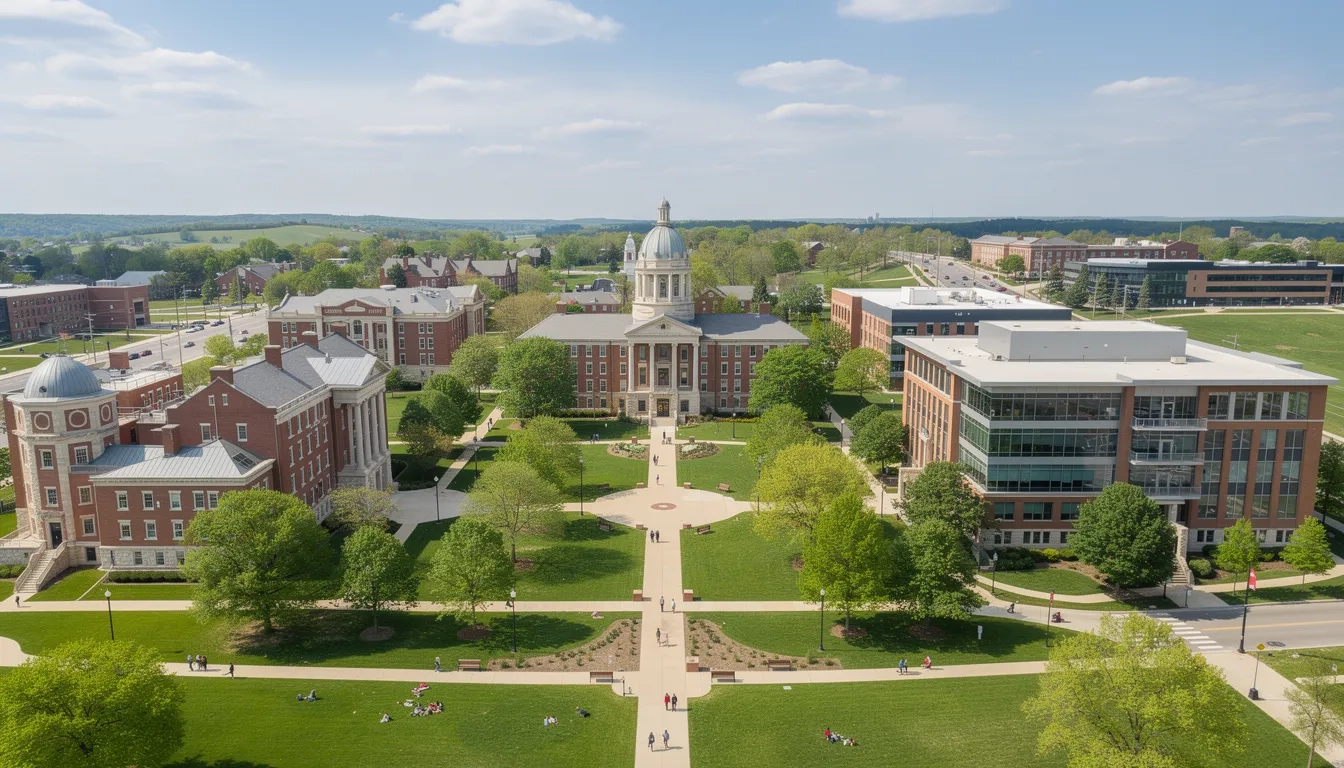
Missouri's higher education system covers more ground than most students realize. You have a world-class private research university. A public flagship with 22,000 undergrads and Big 12 athletics. A STEM specialist in Rolla that barely registers in pop culture rankings but places graduates into Boeing and the Army Corps of Engineers. And tucked near Branson, a school with a 15% acceptance rate that charges almost nothing.
These schools don't really compete with each other the way people assume. A pre-med student, a future petroleum engineer, and someone who wants a tight-knit liberal arts experience are basically shopping in different markets. The key is figuring out which market you're actually in.
Washington University in St. Louis: Missouri's Top Tier
No conversation about Missouri colleges starts anywhere else. WashU ranks #20 in U.S. News & World Report's 2026 national university rankings, the highest-ranked school in the state by a wide margin and one of the top 25 in the country.
Admissions is genuinely selective. The overall acceptance rate sits at 11.8%, but the Regular Decision rate dropped to around 8% in the most recent cycle. Early Decision ran closer to 25%. For students serious about WashU, applying Early Decision is a reasonable strategic move, assuming the finances work. SAT ranges for admitted students sit at 1500–1570.
The research infrastructure doesn't get enough credit in undergraduate conversations. WashU channels over $950 million into research annually. That number becomes concrete when you're a sophomore doing lab work alongside faculty running federally funded studies in medicine, engineering, or social policy.
The student-to-faculty ratio is 4:1 — unusual by any standard. Small seminars, professors who know your name, genuine mentorship. The trade-off is tuition: approximately $55,292 per year. But financial aid is substantial for qualifying families. Running the net price calculator with real income numbers is worth doing before writing the school off as unaffordable.
Mizzou and Missouri S&T: The Public Flagships
The University of Missouri sits at #102 among national universities in the 2026 U.S. News rankings. The journalism school is the oldest in the country and still one of the most respected. Business, education, and engineering are strong. With a 77% acceptance rate and 22,090 undergraduates, Mizzou is genuinely accessible while offering the breadth you'd expect from a flagship — study abroad, hundreds of student organizations, strong alumni networks across the Midwest.
About 93% of Mizzou graduates report employment or graduate school placement within six months of graduation. That's a number worth holding onto.
Then there's Missouri S&T in Rolla, which operates in a different register entirely. U.S. News ranks it #192 nationally overall — but #42 among public engineering schools. That gap tells the whole story. The Wall Street Journal separately ranked Missouri S&T among the top public universities nationally for salary impact, meaning graduates out-earn what their debt load would predict.
The specific program numbers are striking. Petroleum Engineering ranked 14th nationally in 2026. Nuclear Engineering placed 21st. Environmental Engineering jumped from 54th to 46th in a single year. Computer Engineering moved from 85th to 69th. These aren't vaguely "good programs" — they show up directly in hiring conversations at companies doing real engineering work.
Here's a comparison of the major options:
| School | US News 2026 Rank | In-State Tuition | Acceptance Rate | Known For |
|---|---|---|---|---|
| Washington University (WashU) | #20 | ~$55,292 | 11.8% | Research, Medicine, Law |
| University of Missouri | #102 | ~$13,000 | 77% | Journalism, Business |
| Saint Louis University | #105 | ~$51,100 | 59% | Nursing, Public Health |
| Missouri S&T | #192 | ~$13,500 | ~80% | Engineering, STEM |
| UMKC | #244 | ~$11,000 | 68% | Medicine, Performing Arts |
| Missouri State | #352 | ~$8,000 | 89% | Education, Business |
| Truman State | #1 Midwest Public | $9,132 | ~73% | Liberal Arts, Value |
| College of the Ozarks | Niche Grade: A | ~$0* | 15% | Work-Study Model |
*Tuition is largely offset by the mandatory work-study program for full-time students
The Best Value Schools: Truman State and College of the Ozarks
Truman State University in Kirksville is the most underrated school on this entire list.
Truman has held the #1 public university ranking in the Midwest region for 29 consecutive years, according to U.S. News. That streak reflects genuine academic rigor, not marketing momentum. The 2026 rankings also placed it 4th (tied) nationally for undergraduate teaching quality among regional universities, and 13th for best value — the only Missouri institution in the top 15 on that metric. In-state tuition is $9,132 per year.
Truman runs more like a selective private liberal arts college than a typical state school. Writing-intensive curriculum, small classes, strong pre-professional advising. Four academic disciplines earned individual program rankings in 2026: business, computer science, nursing, and psychology. Students here are academically competitive. For Missouri residents who are cost-conscious and academically strong, Truman is quietly the smart pick.
College of the Ozarks near Branson operates on a model that sounds like a catch until you look at the details. Every full-time student works 15 hours per week on campus plus two 40-hour workweeks per year. That labor covers tuition. Most graduates leave without tuition debt. The Niche grade is A. Acceptance rate: 15%.
The school is religiously affiliated, conservative, and rural — the work assignments are real (agriculture, food service, campus facilities), and the culture is intentional. It's not the right fit for everyone. But for students who align with that environment, it's one of a small number of schools in the country where debt-free graduation is structurally baked into the design rather than just aspirationally encouraged.
Saint Louis University and UMKC: Two Urban Options
Saint Louis University is a Jesuit Catholic institution that has built one of Missouri's strongest health sciences programs without a lot of fanfare. Nursing, public health, and pre-med advising at SLU are well-regarded in regional health systems. The connection to SLU Hospital gives clinical students direct access to real patient care environments — not just simulation labs. Student-to-faculty ratio: 9:1. National rank: #105. Annual tuition: approximately $51,100.
The St. Louis location adds real value. Proximity to a major medical hub, growing tech companies, and a dense corporate presence means internship pipelines that smaller Missouri schools simply can't replicate.
University of Missouri-Kansas City sits on 150 urban acres in Kansas City's Volker neighborhood. The Conservatory (the formal name is the UMKC Conservatory of Music and Dance) has produced working conductors, composers, and performers at a rate that surprises people who haven't looked closely. It's a genuinely strong music program living inside a mid-sized public research university.
The other headline at UMKC is the combined BA/MD program: students admitted directly from high school enter a six-year path to a medical degree, bypassing the standard medical school reapplication process entirely. In-state undergraduate tuition runs about $11,000 per year.
Smaller Missouri Schools Worth Considering
A few smaller institutions consistently outperform their national name recognition:
- Maryville University in St. Louis has expanded hybrid and online delivery while maintaining strong on-campus nursing and design programs for students who want flexibility without sacrificing clinical or studio work.
- Rockhurst University, a Jesuit school in Kansas City, produces strong business and healthcare graduates from a genuinely small campus. Class sizes and faculty access are closer to what you'd expect at a private liberal arts college.
- Drury University in Springfield offers international studies and architecture programs that hold their own against schools with much larger marketing budgets and enrollment numbers.
None of these will appear in the top 100 nationally. But program fit and merit aid sometimes make a smaller school the better financial and academic decision — and Missouri's mid-tier private schools often offer scholarships that can close the gap with public school tuition.
How to Actually Choose
Most students in Missouri are navigating one of three core choices:
Research and prestige vs. cost: WashU and SLU are premium environments. At sticker price, they're expensive. But WashU's aid program is substantial — for some family income levels, the net price ends up lower than a public flagship. Run the numbers before deciding.
Specialized depth vs. breadth: Missouri S&T is the right answer if you're committed to engineering. It's the wrong answer if you're still figuring things out. Mizzou or Missouri State give you more room to explore before locking into a major.
Value over brand name: If you're cost-conscious and academically strong, Truman is the real answer for liberal arts. College of the Ozarks is the real answer if you want zero debt and fit the culture. Missouri State in Springfield gives you a large public school experience at among the lowest in-state tuition in the region.
The gap between $9,132 annual tuition and $55,292 is $184,640 over four years before interest. That math should inform every campus visit — not just the dining hall or the dorm rooms.
One question worth asking any school directly: what percentage of graduates in your specific intended major are employed in that field (not just "employed somewhere") within 12 months? Some schools publish this by program. Others don't. Asking forces an honest conversation about actual outcomes, not averages padded by every major at once.
Bottom Line
Missouri's college options reward students who do the homework instead of defaulting to the biggest name.
- WashU is world-class and worth the application. Run the net price calculator with real income figures — financial aid can make the real cost surprisingly competitive.
- Missouri S&T offers the strongest post-graduation ROI for engineering-focused students, particularly in petroleum (#14 nationally), nuclear (#21), and environmental (#46) engineering.
- Truman State has ranked #1 among Midwest public universities for 29 consecutive years and charges $9,132 per year in-state. For Missouri residents who want rigorous academics at a public price, it's the honest recommendation.
- College of the Ozarks has a model unlike anything else on this list. If the culture fits, no other Missouri school offers the same structured path to debt-free graduation.
- Mizzou remains the well-rounded flagship: accessible, well-resourced, with strong career placement and a campus culture that delivers what you'd expect from a Big 12 university.
Before committing anywhere, talk to current students — not admissions officers. Rankings tell you where a school sits. Students tell you whether it actually fits.
Frequently Asked Questions
Is Washington University in St. Louis part of the Ivy League?
No. WashU is not an Ivy League school — the Ivy League is a specific athletic conference of eight northeastern institutions. But WashU is regularly grouped with Ivy-caliber schools in selectivity and graduate outcomes. Its 11.8% acceptance rate and #20 national ranking put it in the same conversation by most practical measures.
Which Missouri college is best for students pursuing medicine?
Saint Louis University and WashU both have strong pre-med advising and established relationships with top medical schools. UMKC's combined BA/MD program is distinctive — it accepts students directly from high school into a six-year path to a medical degree, eliminating the standard reapplication uncertainty. For students certain about medicine before college, UMKC's accelerated program deserves serious consideration alongside the more prominent options.
How does Missouri S&T compare to more famous engineering schools?
In specific programs, Missouri S&T competes directly. Petroleum Engineering ranks 14th nationally — ahead of schools with much larger national profiles. Nuclear Engineering at 21st is a top-tier placement. The Wall Street Journal's salary impact ranking placed S&T among top public universities nationally, meaning graduates aren't just getting jobs — they're earning more than their debt predicts. For in-state students, the tuition differential makes the comparison even more favorable.
Do Missouri schools have strong employer recognition outside the Midwest?
WashU graduates encounter no regional recognition issues — it's a nationally known research institution. Missouri S&T engineering graduates are well-known to energy, defense, and infrastructure employers nationwide. For Mizzou, SLU, and Truman, recognition varies by industry. Regional Midwest employers actively recruit from all of these schools, but students targeting coastal tech companies or national consulting firms should plan on building strong internship records to complement the degree.
Is the College of the Ozarks work program actually manageable alongside coursework?
Students and alumni generally report it as manageable — 15 hours per week is comparable to what many college students work at off-campus jobs anyway, and the schedule is structured rather than unpredictable. The bigger question is cultural fit. The campus is religiously conservative, rural, and deliberately shaped around a character development mission. Students who don't align with that environment often find it more restrictive than freeing. Research the campus culture as carefully as you research the financial model.
What's the difference between Missouri State University and Truman State University?
They're quite different despite the similar names. Missouri State in Springfield is a large comprehensive university with 22,000-plus students, strong business and education programs, and Division I athletics. Truman State in Kirksville is smaller, more academically selective, and focused on liberal arts and sciences. Truman has ranked #1 among Midwest public regional universities for 29 consecutive years; Missouri State ranks lower overall but offers more program variety and a larger campus experience. The choice often comes down to whether you want breadth or academic intensity.
Sources
- 2026 Best Colleges in Missouri | U.S. News Rankings
- Missouri S&T Remains State's Top Public Grad School for Engineering | Missouri S&T News
- Truman Earns No. 1 Ranking for 29th Consecutive Year | Truman Today
- Top Universities in Missouri 2026 | Rankings & Admissions Guide
- Best Colleges in Missouri | Stacker
- 2026 Best Colleges in Missouri | Niche