Best Colleges With Strong Career Counseling in 2026
The average student-to-career-counselor ratio at American universities is 1,846 to 1. Read that again. Nearly 1,900 students for one counselor — at schools charging $50,000+ per year.
That figure comes from NACE (National Association of Colleges and Employers), and it explains why so many graduates cross the stage feeling academically prepared but professionally lost. Career services departments at most schools exist to check a box. But a handful of colleges have built programs that genuinely change what happens after graduation, and knowing which ones they are before you apply could be worth more than obsessing over rankings tiers.
The Rankings You Should Actually Trust
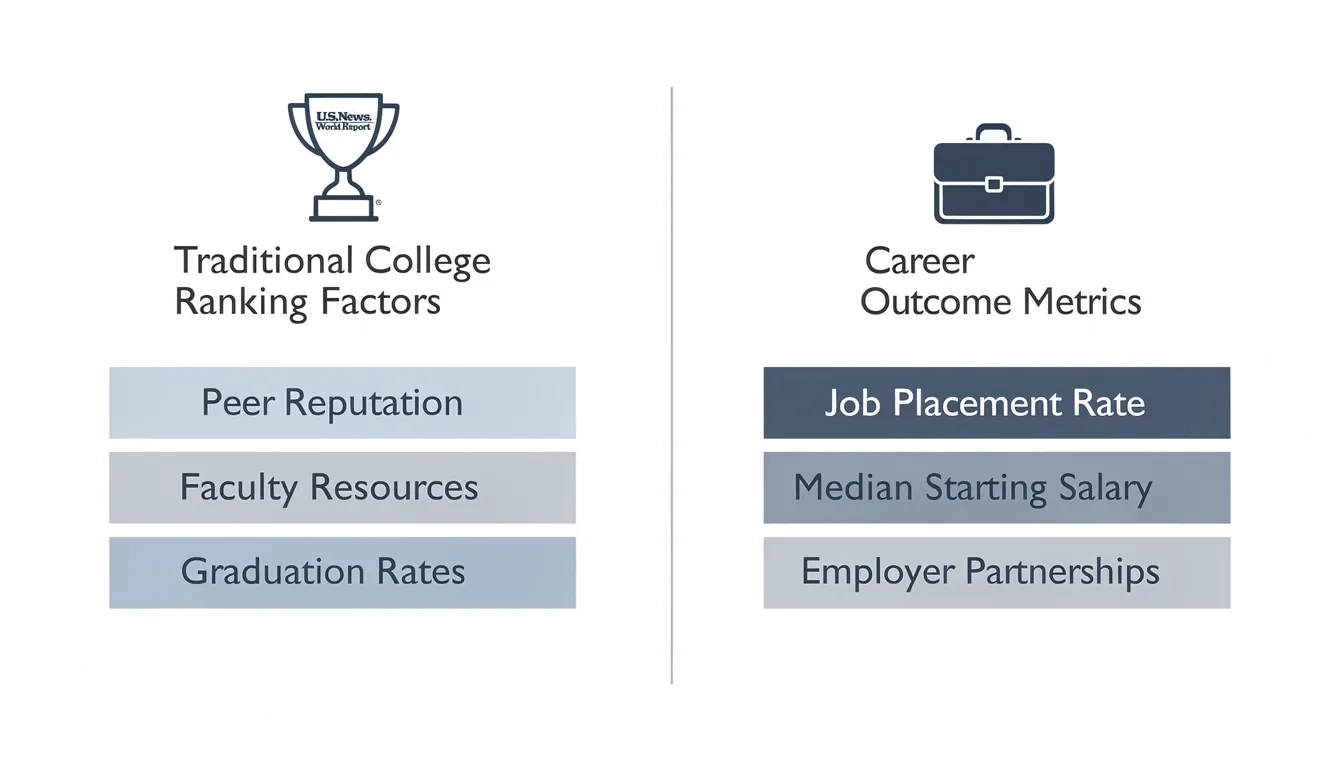
Most popular college rankings mostly ignore career outcomes. U.S. News & World Report weights peer reputation, faculty resources, and graduation rates — useful signals, but not a direct read on what happens to you six months after you leave.
The Princeton Review takes a different approach. Each year, they survey 170,000+ actual students across 391 schools about the quality of career services. No admissions office spin. Students rate the counselors, resources, and opportunities they personally experienced.
For 2026, Princeton Review named Bentley University, Denison University, and Washington and Lee University as its top three schools for career services — ahead of Stanford, Penn, and every Ivy League school. That result surprises most people. It shouldn't.
The other credible signal is placement rate data, though you have to read it carefully. Schools report "employed or continuing education" outcomes using first-destination surveys, which capture self-reported data from roughly 70% of graduates. A 95% placement rate can mean very different things depending on whether part-time barista jobs and unpaid fellowships are counted in the tally.
2026's Top-Ranked Schools
Bentley University in Waltham, Massachusetts took the #1 spot. Bentley's model is built around career integration from the first semester — employer relationships are cultivated at the institutional level, and every undergraduate program includes career-focused coursework. With 4,526 full-time students and an identity built around business education, the entire campus is pointed toward professional outcomes.
Denison University in Granville, Ohio at #2 is perhaps the more surprising entry. With about 2,394 students, Denison's small size is probably its biggest advantage. Smaller schools maintain lower student-to-counselor ratios, and their alumni networks — smaller in absolute numbers — tend to run unusually tight. Liberal arts schools like Denison have faced enormous pressure to justify their tuition, and many responded by building genuinely strong career infrastructure.
Washington and Lee University rounds out the top three. With just 1,886 students, W&L has the smallest enrollment of the three, and an alumni network with a legendarily strong "take care of our own" reputation. Their career programs include rigorous mock interview rotations and dedicated externship programs where students shadow working alumni in actual professional settings.
Other schools consistently recognized across multiple credible rankings include:
- Wake Forest University (Winston-Salem, NC) — Pro Humanitate Office of Personal and Career Development, plus mandated career readiness curriculum
- Villanova University (Villanova, PA) — Colleges of Distinction recognition; strong corporate recruiting from the Philadelphia/New York corridor
- Colgate University (Hamilton, NY) — COOP (Colgate Career Opportunities and Orientation Program), which starts during orientation week
- University of Texas at Austin — Career Exploration Center serving 50,000+ students with a CareerExplorer digital platform
- Fairfield University — ranked #22 in Princeton Review's 2025 Best Career Services list
What Separates Good Career Services from Great
The Napa Group's 2025 industry report on career services in higher education identified a consistent pattern across top-performing institutions. The differentiator isn't the number of job postings in a student portal.
"The best programs introduce students to career services as early as their first year — before students think they need it."
Here's what that actually looks like on the ground:
1. Year-one integration. Schools like Bentley and Colgate don't wait for panicking juniors. They run career assessments and networking practice during the first semester. Students who start building professional habits as sophomores have two extra summers to accumulate relevant experience before graduation — that compounds.
2. Real employer relationships. The difference between a career fair that matters and one that doesn't comes down to whether employers are recruiting or just scanning faces. Top programs build year-round partnerships where companies help design curriculum and host students for site visits.
3. Staff depth and actual access. The national 1,846:1 ratio is genuinely dysfunctional. At well-resourced career centers, that ratio drops to 200:1 or lower. If a student can book a same-week appointment with a counselor who knows their specific industry, that's a real advantage.
4. Paid internship placement. Internship programs aren't equal. The Napa Group found that paid internships produce significantly better full-time employment outcomes than unpaid ones. By 2024, 84% of graduates had engaged in some form of experiential learning, up from 71% in 2021.
5. AI-ready career tools. Leading institutions now deploy platforms with AI-driven resume feedback and mock interview simulation (tools like Big Interview are widely used). About 75% of knowledge workers currently use AI daily on the job. Career centers that build those skills early aren't just preparing students for interviews — they're preparing them for the work itself.
School Comparison: Career Services Across Key Metrics
| School | PR 2026 Rank | Enrollment | Notable Feature | Known For |
|---|---|---|---|---|
| Bentley University | #1 | 4,526 | Business-integrated career model | Finance, accounting, marketing |
| Denison University | #2 | 2,394 | Tight alumni mentorship network | Liberal arts career adaptability |
| Washington & Lee | #3 | 1,886 | Externship + mock interview programs | Law, consulting, alumni loyalty |
| Wake Forest | Top 10 | 5,285 | Mandatory career readiness curriculum | Business, pre-professional tracks |
| Villanova | Top 25 | 7,000+ | Philadelphia/NYC corporate pipeline | Business, engineering |
| Colgate | Top 25 | 3,100 | COOP program starts at orientation | Finance, consulting |
| Stanford | Not ranked | 7,700+ | Silicon Valley employer access; 97% placement | Tech, engineering, entrepreneurship |
| MIT | Not ranked | 4,600+ | 96%+ placement; deep engineering recruiting | Engineering, computer science |
| Howard University | Not ranked | 11,000+ | #1 HBCU by LinkedIn metrics; 95%+ outcomes | Government, healthcare, media |
The Big-Name vs. Career-Focused School Debate
Here's the honest take that most college guides skip: a prestigious name and strong career services are not the same thing.
Stanford's 97% employment rate is real. But Stanford's career center serves 7,700 undergraduates, and students largely get hired because they're Stanford students. Employers come to them. The career center is almost beside the point.
At a school like Bentley or Denison, the career center is the point. It's the actual mechanism. Remove it and outcomes would drop sharply. That distinction matters enormously if you're not attending a school where the diploma alone opens doors on contact.
A 2025 Wiley meta-analysis examining 35 independent studies (totaling 4,327 participants) found that individual career counseling produced large effect sizes on career outcomes across a range of measures. The effects were strongest for students without built-in advantages — first-generation students, students from lower-income backgrounds, students uncertain about direction. Separate longitudinal research found that low-income students who received structured career guidance earned 10% more at age 28 than comparable peers who didn't.
So the argument for prioritizing career services quality isn't just about feelings of support. There's real money attached to it.
Red Flags and Green Flags When Evaluating Career Centers
Tour the career center on your campus visit. Ask specific questions. Don't accept vague answers like "we have great employer connections" — that's the first red flag.
Green flags:
- A dedicated counselor for your intended field, not one generalist covering everything
- Published first-destination surveys with response rates above 70%
- Specific data on paid internship placement, not just "participation" numbers
- Alumni mentorship programs with active, reachable contacts
- Career services office in a visible, central campus location (not tucked behind administration in a building no one visits)
Red flags:
- Career center hours are 9 to 5, Monday through Friday (students have classes then)
- Staff cannot tell you the average starting salary for graduates in your intended major
- "Placement rate" includes unpaid internships, volunteer work, or part-time retail jobs
- No dedicated recruiting events for your field of interest
- The career center feels like an afterthought on the campus tour, because it is
One concrete test: email the career center before you apply and ask how many counselors specialize in your intended field. If they don't respond within 48 hours, or if the answer is "we have generalists who cover everything," you now have the data you need to weigh that school accurately.
Bottom Line
- The Princeton Review's 2026 top picks for career services are Bentley University (#1), Denison University (#2), and Washington and Lee University (#3) — based on surveys of real students, not institutional self-reporting.
- Career services quality matters most at schools outside the top-20 prestige tier, where the diploma alone won't open doors. At those schools, the career center is a primary driver of financial outcomes.
- Three questions to ask on every campus tour: What is your student-to-counselor ratio? Can I see your published first-destination survey? What percentage of internships in my intended field are paid?
- The right time to start using a college career center is the first week of freshman year. Schools that build that expectation from day one are worth choosing.
Frequently Asked Questions
What is the #1 college for career services according to the Princeton Review in 2026?
Bentley University in Waltham, Massachusetts ranked #1 for career services in Princeton Review's 2026 guide. Rankings are based on surveys of 170,000+ real students across 391 schools, making this one of the more credible student-sourced assessments available. Denison University and Washington and Lee University took the #2 and #3 spots respectively.
Do Ivy League schools have the best career services?
No — and this is one of the more persistent misconceptions in college planning. Ivy League schools produce outstanding employment outcomes, but those outcomes are driven primarily by employer demand for the degree name and by alumni networks, not by the quality of advising. Schools like Bentley, Denison, and Wake Forest consistently outrank Ivy League institutions specifically on career services quality in student surveys.
How important is career counseling for first-generation college students?
Particularly significant. A Wiley meta-analysis published in 2025 found large effect sizes for individual career counseling on career outcomes, with the strongest results for students facing informational and structural barriers. Separate longitudinal research found that low-income students who received structured career guidance earned 10% more at age 28 than comparable peers who did not, partly because those students faced larger informational gaps about professional norms and hiring processes.
What should I look for in a college career center during a campus visit?
Ask about the student-to-counselor ratio, whether there are industry-specific advisors for your intended field, and whether the school publishes a first-destination survey with a response rate above 70%. Walk through the career center at an unscheduled time to see whether students are actually using it. Request data specifically on paid internship placement rates — not just general "internship participation."
Is a high job placement rate always a reliable sign of strong career services?
Not automatically. Some schools count unpaid internships, volunteer work, or part-time employment in their placement figures. The most reliable metric is a published first-destination survey conducted six months after graduation, with a high response rate and clear definitions of what counts as "employed." Schools that publish this data transparently and without burying the methodology tend to have stronger programs overall.
When should students start using their college career center?
Freshman year. Career centers at top-performing schools now embed programming into first-year experience courses, not just senior spring workshops. Students who start career assessments and informational interviews as first-years have two or three extra summers to build relevant experience before graduation, which compounds significantly by the time they're competing for jobs against students who waited until October of senior year.
Sources
- Princeton Review's 2026 Best Colleges: Top Schools for Career Services — Poets&Quants
- Trends and Best Practices in Career Services at Colleges and Universities, 2025 — The Napa Group
- Top Colleges with Exceptional Career Services — Colleges of Distinction
- Top US Colleges with Best Job Placement Rates: 2026 — Best Job Search Apps
- A Meta-Analysis of the Effectiveness of Individual Career Counseling — Wiley / Journal of Employment Counseling, 2025