Best HBCUs in America 2026: Rankings, Costs & How to Choose
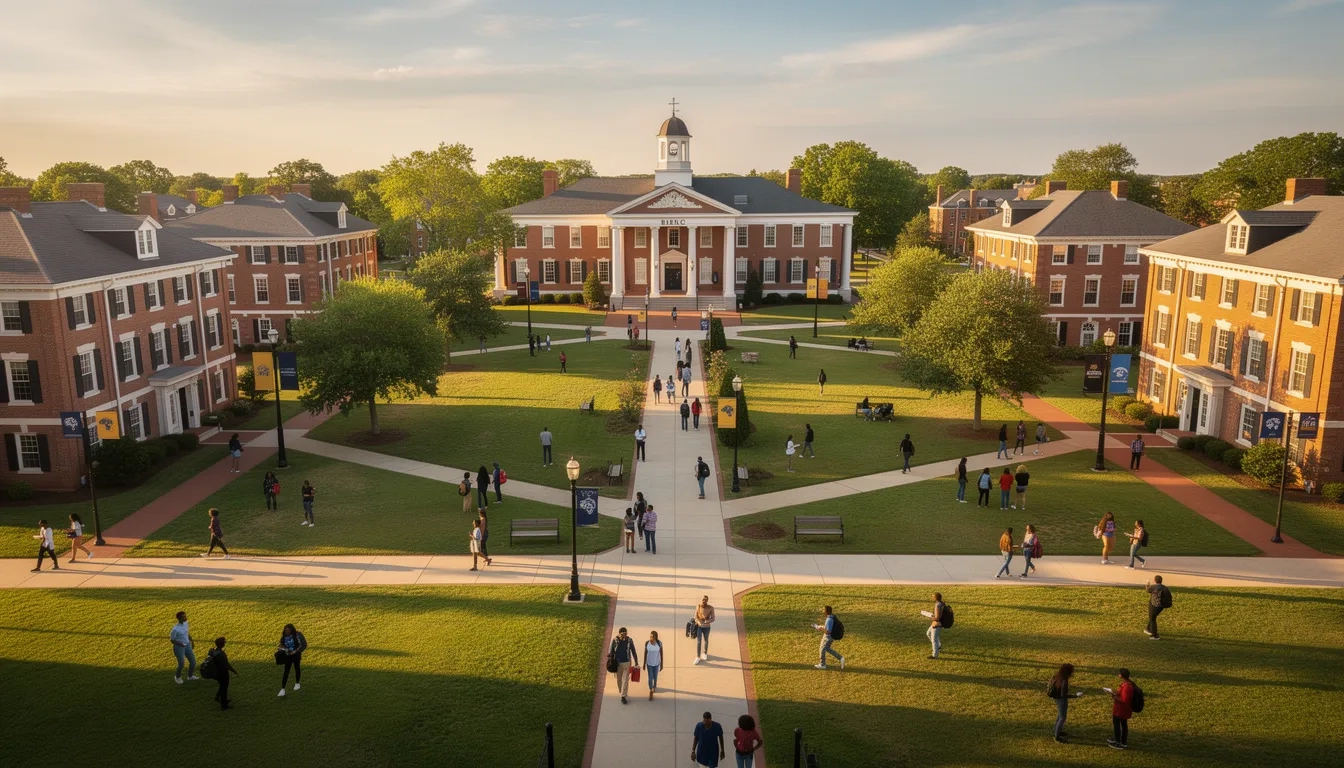
HBCUs enroll about 3% of all college students in America. Yet they produce 70% of the country's Black doctors and dentists, 50% of Black engineers, and 35% of Black lawyers. Whatever you think about college rankings, those numbers tell a story — and the 2026 data makes the case stronger than ever.
Why HBCUs Outperform Their Size
The full picture starts with 99 HBCUs spread across 19 states and Washington D.C., enrolling roughly 290,000 students. Small footprint. Enormous output.
The professional pipeline is the headline number. HBCUs award 25% of all STEM bachelor's degrees earned by Black Americans. For a group of schools representing 3% of total enrollment, that's a structural advantage, not an accident.
Part of the explanation is mentorship density. At a school like Spelman College (2,300 total students), you don't disappear into a lecture hall of 400 people. Professors know your name by week three. Research opportunities that would require junior or senior standing at a large research university are often available to freshmen at HBCUs, where faculty actively pull students into their labs and projects.
There's also the community factor. For students who spent K-12 as one of the few Black students in their school, arriving somewhere that centers rather than merely accommodates their identity has documented effects on confidence, academic performance, and retention. A 2023 United Negro College Fund report found that HBCU alumni report significantly higher rates of having "a professor who cared about me as a person" compared to Black graduates of predominantly white institutions. Those relationships translate into references and professional networks that follow you for decades.
The Rankings Debate: US News vs. Forbes
Here's where 2026 gets interesting. Two major ranking systems give the #1 spot to two different schools.
U.S. News & World Report has ranked Spelman College as the top HBCU for the 19th consecutive year. Their methodology weights graduation rates, social mobility, faculty resources, and post-graduate outcomes heavily — with outcome indicators accounting for more than half the total score. Spelman's #2 national ranking for social mobility (across all 1,700+ ranked institutions, not just HBCUs) is what anchors that result.
Forbes, through its 2026 America's Top Colleges list, ranked Howard University #1 among HBCUs for the second straight year. Forbes focuses on return on investment, average debt at graduation, post-graduation earnings, and how well schools serve Pell Grant recipients. LinkedIn separately ranked Howard as the top HBCU for graduate career success and job placement. Howard students graduate with measurably lower debt than peers from Georgetown, George Washington University, and American University — all in the same city, all charging far more.
These aren't contradictory rankings. They're measuring different things.
If social mobility and academic prestige drive your decision, Spelman's 19-year run is hard to argue with. If post-graduation salary and debt minimization matter more, the Forbes and LinkedIn data consistently point to Howard.
Pick the ranking whose values match yours.
Top HBCUs in 2026: The Full Breakdown
Here's how the leading schools compare across the metrics that actually matter for your decision:
| School | Location | Type | Acceptance Rate | Avg. Annual Cost | Known For |
|---|---|---|---|---|---|
| Spelman College | Atlanta, GA | Private, Women's | ~39% | $31,000 | STEM, pre-med, liberal arts |
| Howard University | Washington, DC | Private, Research | ~35% | $32,000 | Medicine, law, journalism, engineering |
| Hampton University | Hampton, VA | Private | ~36% | $29,000 | STEM, business, sciences |
| Xavier University of Louisiana | New Orleans, LA | Private | ~63% | $25,000 | Pre-med, pharmacy, sciences |
| Morehouse College | Atlanta, GA | Private, Men's | ~60% | $30,000 | Business, engineering, pre-med |
| Tuskegee University | Tuskegee, AL | Private | ~31% | $27,000 | Engineering, aerospace, agriculture |
| North Carolina A&T | Greensboro, NC | Public | ~62% | $18,000 | Engineering, computer science |
| Florida A&M University | Tallahassee, FL | Public | ~31% | $17,500 | Pharmacy, business, agriculture |
| Fisk University | Nashville, TN | Private | ~66% | $24,000 | Arts, sciences, history |
| Morgan State University | Baltimore, MD | Public | ~65% | $19,000 | Engineering, public health |
The Atlanta corridor stands apart from everything else. Spelman and Morehouse share a campus in the Atlanta University Center Consortium, alongside Clark Atlanta University and Morehouse School of Medicine. Students can cross-register for courses across institutions. The surrounding city — one of the fastest-growing Black professional markets in the country — functions as a living internship program.
Florida A&M has held its title as the top-ranked public HBCU for seven consecutive years. Their pharmacy school ranks nationally, and in-state tuition sits around $6,000–$9,000 before aid, making it one of the strongest value propositions on this entire list.
Beyond the Top Five: Schools With Real Superpowers
Linear rankings flatten details that matter enormously at the individual level. Several schools not in the top five are genuinely elite in specific fields.
Tuskegee University in Alabama has an engineering and aerospace legacy that traces directly to the Tuskegee Airmen. Their College of Engineering has placed graduates at NASA and Boeing for generations. If aerospace is your field, Tuskegee's alumni network in that industry competes with schools ranked far above it — the connections are deep and specific.
North Carolina A&T is the largest HBCU in the country by enrollment (over 14,000 students). It holds R2 doctoral research university status, which means real research funding, graduate programs, and lab infrastructure that smaller HBCUs simply can't offer. A&T ranks in the top three for HBCU reputation, and their engineering and computer science programs regularly feed into tech companies.
Xavier University of Louisiana deserves its own category for pre-med students. Xavier has consistently sent more Black students to medical school than almost any other undergraduate institution in the country — not "among HBCUs," any institution. In 2022–2023 alone, 59 Xavier students reported acceptances into medical, dental, and other health professions programs. Xavier also recently launched the Xavier Ochsner College of Medicine in partnership with Ochsner Health, creating a pipeline from undergraduate study directly through an MD within the same institution. For students serious about becoming physicians, this is worth serious attention.
Fisk University in Nashville enrolls under 1,000 students (one of the smallest on this list) but offers a DuBois-Fisk UNCF Data Science program and a formal partnership with Vanderbilt University that gives students access to research resources most small liberal arts colleges couldn't dream of providing.
What You Actually Pay — and What It Returns
Sticker price at HBCUs can be genuinely misleading. The real number is net cost after aid, and the gap between those two figures is often significant.
Private HBCUs like Spelman, Howard, and Morehouse carry tuition in the $28,000–$41,000 range. But merit scholarships at these schools can be aggressive. Students with strong academic profiles often see net costs drop to $16,000–$23,000 annually — comparable to attending a mid-tier public university. Spelman's merit awards, for instance, can cover 50–100% of tuition for high-achieving admitted students.
Public HBCUs reshape the math entirely:
- Florida A&M (in-state): ~$6,100/year
- North Carolina A&T (in-state): ~$7,000/year
- Morgan State in Maryland (in-state): ~$8,200/year
- Prairie View A&M in Texas (in-state): ~$8,400/year
The collective economic weight of these schools isn't trivial either. According to data cited in Spelman's 2025 rankings press release, HBCUs generate $16.5 billion in direct economic impact nationally — a signal that graduates are employed, earning, and building wealth in their communities.
One financial avenue that students consistently overlook: the HBCU Scholarship Program through the U.S. Department of Education provides need-based aid specifically for HBCU students. Students who qualify for Pell Grants and apply early to schools with well-staffed financial aid offices often find their actual cost of attendance falls well below what any online calculator shows. Apply early, call the financial aid office directly, and negotiate.
How to Choose — A Practical Framework
The most common mistake I see students make is asking "which HBCU is best?" The better question is "best for what, and for whom?"
Here's how to think through it by career goal:
For medical school and health professions: Xavier University of Louisiana (deepest physician pipeline, new in-house medical school), Spelman (top-2 social mobility, strong STEM infrastructure), or Howard (pre-med program backed by Howard University Hospital partnerships).
For engineering, computer science, or aerospace: North Carolina A&T (R2 research university, largest engineering cohort among HBCUs), Tuskegee (aerospace and agricultural engineering legacy), or Prairie View A&M (Houston energy and tech job market access).
For business, law, policy, or media: Howard University wins here. The Washington D.C. location means internships with federal agencies, think tanks, major law firms, and media organizations that no other HBCU can match geographically. Morehouse is the Atlanta parallel for business.
For maximum affordability with strong outcomes: FAMU, North Carolina A&T, Morgan State, and Prairie View A&M all deliver competitive programs at public school prices.
My honest take: the HBCU-vs.-PWI debate gets framed wrong too often. The question isn't which type of school is "better." It's which environment lets you perform at your ceiling. For many Black students, that ceiling is measurably higher at an HBCU — the mentorship is closer, the community is tighter, and the professional networks are built specifically around your success.
Students who start researching HBCUs and visiting campuses in the spring of 11th grade can compare actual financial aid packages before committing to anything. And here's a practical note: many HBCUs run application fee waiver periods regularly. Howard, Spelman, and Morehouse all offer them at various points in the year, so you can apply to several schools without spending $23,847 in fees before you've seen a single acceptance letter (the fees add up fast when you're applying broadly).
Bottom Line
The 2026 rankings confirm what HBCU advocates have argued for a long time: these schools consistently outperform their size in producing Black professionals, scholars, and leaders. And the financial case has gotten stronger, not weaker.
- For academic prestige and social mobility, Spelman College holds the U.S. News #1 spot for the 19th straight year — that's not a fluke.
- For career earnings and debt outcomes, Howard University leads on Forbes and LinkedIn data, graduating students with less debt than any comparable Washington D.C. university.
- For the best value among public HBCUs, Florida A&M (seven-year run as top public HBCU) and North Carolina A&T (R2 research, 14,000+ students) offer competitive programs at a fraction of private school cost.
- For pre-med specifically, Xavier University of Louisiana has a physician production track record that no other undergraduate institution in the country can match.
Visit campuses before you commit. The rankings tell you one story. The moment you walk into homecoming at Howard or sit in a Spelman science lab, you'll understand the part the data can't fully capture.
Frequently Asked Questions
Is Spelman or Howard the #1 HBCU in 2026?
Both, depending on who you ask. U.S. News & World Report has ranked Spelman #1 for 19 consecutive years, weighing graduation rates, social mobility, and academic outcomes. Forbes ranked Howard #1 for 2026 based on return on investment, post-graduation earnings, and debt levels. These schools genuinely lead in different categories — Spelman for upward mobility metrics, Howard for career earning outcomes and debt minimization.
Are HBCUs only for Black students?
No. HBCUs are open to students of all racial backgrounds, and many have notable non-Black enrollment. The "historically Black" designation refers to the institutions' founding and original mission, not an admissions restriction. That said, campus culture, traditions, and community at HBCUs are intentionally built around Black history and identity — that's a central part of the experience for most students who choose to attend.
Do employers treat HBCU degrees the same as degrees from other universities?
Yes, and salary data backs it up. Forbes' 2026 rankings methodology found that Howard graduates earn comparable or higher post-graduation salaries relative to graduates of other Washington D.C. universities. Major employers including Google, Goldman Sachs, Deloitte, and federal agencies actively recruit at HBCU campuses. The career risk comes from choosing a low-quality school of any type — not from choosing an HBCU.
Which HBCU is best for pre-med students?
Xavier University of Louisiana has the strongest track record of placing Black students into medical school of nearly any undergraduate institution in the country. Spelman and Howard are also strong choices, with Howard backed by Howard University Hospital. Xavier's new Xavier Ochsner College of Medicine — launched in partnership with Ochsner Health — now creates a potential pathway from Xavier's undergraduate campus directly into an MD program.
How much financial aid can I expect at an HBCU?
It varies widely by school type. Public HBCUs like FAMU and NC A&T cost under $10,000/year for in-state students before any additional aid. Private HBCUs carry $28,000–$41,000 sticker prices, but merit scholarships frequently bring net costs to $16,000–$23,000. The U.S. Department of Education also runs an HBCU-specific scholarship program for students with financial need. Applying early and calling the financial aid office directly consistently produces better results than accepting the first offer.
Are smaller HBCUs worth considering, or should I focus only on top-ranked schools?
Smaller HBCUs can be excellent depending on your goals. Fisk University (under 1,000 students) offers a Vanderbilt University research partnership that's genuinely unusual for a school its size. Tuskegee's aerospace engineering alumni network outperforms its ranking in that specific field. The rule is to match the school's specific strengths to your specific goals — a top-5 HBCU in the wrong field may serve you worse than a lower-ranked school with a direct pipeline into your target career.
Sources
- U.S. News & World Report Ranks Spelman College No. 1 HBCU for the 19th Consecutive Year
- Forbes Magazine Names Howard University as Top HBCU In the Nation for the Second Year in a Row
- Best HBCUs 2026: Rankings, Scholarships & Why They Matter
- HBCU Rankings 2026: Best Historically Black Colleges & Universities
- Top 10 HBCUs 2026 | Rankings, Scholarships & Comparison | ThriveHBCU
- How Xavier University sends more Black grads to medical school than almost any other college