College Interview Tips for Virtual and In-Person Formats
The email lands in mid-October: "We'd love to schedule an interview." For most students, those eight words kick off a mix of relief (they noticed me) and quiet dread (now what do I actually say?). But here's what most prep guides won't tell you: the interview almost never makes or breaks an admission. What it does is add texture to a file that readers have already reviewed. Done well, it turns a strong applicant into a memorable one — and that gap is absolutely worth preparing for.
Know What Kind of Interview You Have
Not all college interviews work the same way. Prepping for the wrong type is a quiet way to underperform before you've even started.
Evaluative interviews carry direct weight. Schools like Rice University and most Ivy League programs assign formal scores to evaluative interviews, and those scores go into your file. Vague enthusiasm won't move the needle here. Your answers need structure, your examples need specificity, and you need to quantify outcomes where possible. Informational interviews, by contrast, are genuinely more relaxed — they exist so you can ask questions, not so the school can grade you.
Who is conducting the interview matters just as much as the format. Alumni interviewers cannot see your application. They know your name and high school, and that's it. Admissions staff interviewers may have read your full file, including essays, before you walk in. With an alum, you need to reintroduce context they simply don't have access to.
Then there's the virtual question. Columbia eliminated alumni interviews entirely for 2025-2026. Brown now offers optional video introductions. But Harvard, Yale, Princeton, Stanford, and MIT continue treating the interview as a meaningful signal in their evaluation. According to SelectiveAdmissions' 2025-2026 guide, knowing which category your target school falls into shapes how much preparation depth you actually need.
How to Prepare in One Week
Most students read interview tips online for a couple of hours, then wonder why they freeze when real questions start coming. Reading about interviews is not preparation. Talking out loud is.
Here's a 7-day framework that covers the right ground:
- Day 1 — Research three academic programs, two research labs or centers, and two student organizations at the school
- Day 2 — Write a 60-second "Tell me about yourself" answer and practice it until it sounds natural, not memorized
- Day 3 — Build 5 to 6 STAR stories (Situation, Task, Action, Result) covering leadership, a setback, intellectual curiosity, teamwork, and service
- Day 4 — Write six thoughtful questions to ask your interviewer
- Day 5 — Conduct a full mock interview with a parent, teacher, or counselor; record it if you can stand watching it back
- Day 6 — Confirm logistics: time zone, meeting link or campus directions, what to bring
- Day 7 — Light review only, then rest and protect your voice
One pattern worth calling out directly: "Why this school?" is consistently the weakest answer in most student interviews. Students spend so much time preparing personal questions that they forget to research the school with any real depth. If your answer could apply to three other universities, it's not a real answer. Name a specific professor's research, a specific lab or center, a course structure you can't find elsewhere — and connect it to something you've already done or want to do.
Virtual Interviews: The Setup Details That Actually Matter
Technical failures during virtual college interviews happen more than people admit. Logging in 45 seconds late because your browser needed an update is not a strong opening.
Camera position is the single most underrated factor. Most students prop a laptop on a desk and end up staring downward at the screen, which creates a disengaging angle and makes them look checked-out. Raise your screen to eye level so the interviewer's face appears roughly level with yours — a stack of hardcovers works perfectly fine (and costs nothing).
Lighting matters more than your background. The most common error: sitting with a window or lamp behind you, which turns you into a silhouette. Sit facing your light source instead. Natural window light works well. A basic ring light costs around $23 and eliminates the lighting variable entirely, regardless of weather or time of day.
For clothing on camera, CollegeVine's guidance is specific: jewel tones — blues, greens, purples — translate well on most screens. Avoid bright white (it can wash out your face) and solid black. Small patterns cause visual distortion on compressed video. Always dress business casual from head to toe, even though the interviewer only sees your top half. Being fully dressed affects how you carry yourself.
Always have your phone's hotspot ready as a backup. Internet drops happen. Interviewers understand technology. What they're watching for is whether you recover quickly and calmly. Keep a glass of water nearby, too — dry mouth mid-answer disrupts your train of thought at exactly the wrong moment.
In-Person Interviews: Small Stuff That Leaves Big Impressions
The in-person interview starts before you walk in the door. Reception staff sometimes share observations with interviewers — not as a formal part of the process, but as a human one. The student who was curt with the front desk assistant and then charming in the room is not a new story.
Arrive 10 to 12 minutes early. Not 20 (you'll make the front desk awkward) and not 3 (no buffer for anything going sideways). Twelve minutes gives you time to look around the space — posters, student research displays, departmental flyers. These are material for questions or casual conversation.
IvyWise coaches specifically note the handshake detail: web-to-web contact, two pumps, medium pressure. That sounds like overthinking until you realize how quickly a limp or crushing handshake registers with someone who meets dozens of students each week. First impressions form fast.
Bring a clean one-page resume. Not a portfolio stuffed with certificates. The interview is a conversation, not a performance review. But a simple resume gives an alumni interviewer a quiet reference tool when they don't have your application in front of them — and many appreciate it.
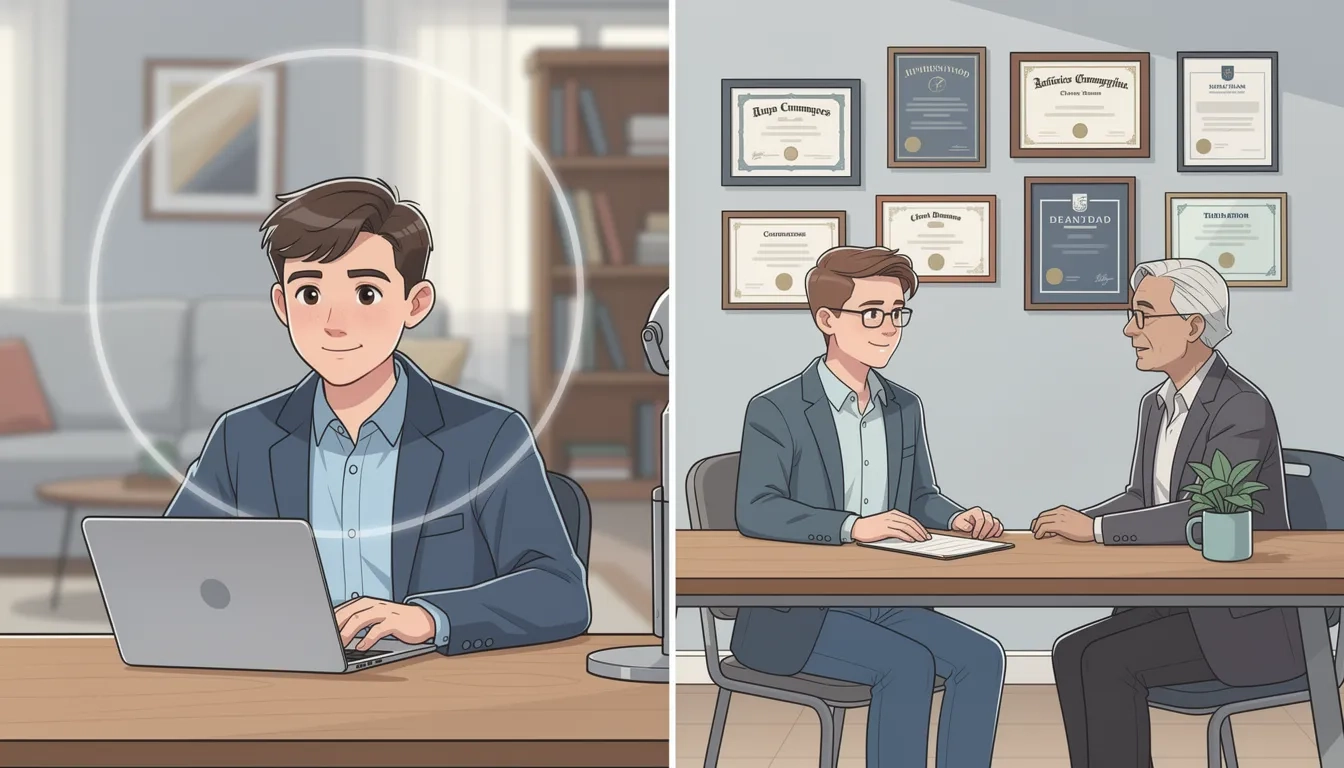
| Factor | Virtual | In-Person |
|---|---|---|
| Clothing | Jewel tones; full business casual, head to toe | Business casual; neat and comfortable |
| Timing | Log in 5 min early; full tech test the day before | Arrive 10–12 minutes early |
| What to bring | Charged device, backup hotspot, water, off-screen notes | One-page resume, pen, notepad |
| Body language | Camera at eye level, face lit from the front | Open posture, steady eye contact, firm handshake |
| Interruptions | Silence phone, alert household, close all other apps | Silence phone; step outside to collect yourself first |
| Follow-up | Thank-you email within 24 hours | Handwritten note if interviewing with an alumnus |
Keep your hands visible and relatively still during the conversation. Clenched fists in your lap, crossed arms, or nervous pen-clicking signal anxiety in ways you can't see but the interviewer absolutely can.
The Questions You'll Face (And How to Actually Answer Them)
The questions aren't secrets. Most interviewers pull from a fairly predictable set:
- "Tell me about yourself"
- "Why do you want to attend this school specifically?"
- "Describe a challenge you've faced and how you handled it"
- "What book, idea, or experience changed how you think?"
- "What would you contribute to our campus community?"
- "What would your closest friends say about you that wouldn't show up on your application?"
The STAR method — Situation, Task, Action, Result — keeps your answers from wandering. Cover what happened, what role you played, what you did, and what came out of it. Then add one sentence of reflection. Interviewers don't just want to know what happened. They want to know what you made of it.
The most common mistake is answering in abstractions. "I'm really passionate about helping people" is not an answer anyone can evaluate. "I redesigned the intake form for our school tutoring program after noticing the 17-step signup process was losing students before they ever got help — sign-ups went up 40% the following semester" is an answer. Specificity is what separates memorable candidates from forgettable ones.
The strongest interviews feel like thoughtful conversations rather than formal evaluations.
That line from SelectiveAdmissions captures what all the frameworks can obscure. The students who perform best aren't the ones with the most polished answers. They're the ones who treat the meeting like a conversation they genuinely want to have.
The Questions You Should Ask
Most students either blank here, ask something answerable on the school's homepage, or say "I think you've covered everything" — which lands as disinterest no matter how politely it's delivered.
Questions that consistently land well:
- "How do first-year students typically get involved in research, and how early does that usually start?"
- "Looking back at your own time here, what do you wish you'd known before arriving?"
- "What distinguishes the strongest faculty-student relationships at this school?"
- "Is there something about [specific program or center] that's shifted recently that I might not have read about?"
Questions about dorms, parking, or social life during an evaluative interview tend to signal that you're focused on comfort, not academics. Save those for the campus tour.
My honest take: asking zero questions at the end of an interview is the single worst thing you can do. It reads as disinterest, not modesty. If you're genuinely blanking, say: "You actually addressed a few of my main questions already — could you say more about how [specific thing you mentioned] works for incoming students?" That recovers the situation and proves you were listening.
After the Interview: Don't Drop the Ball
The interview ends and most students go home and move on with their day. Big mistake.
Send a thank-you email within 24 hours. Not a week later, not a generic "thanks for your time." Something that references a specific point from the conversation: "I appreciated what you said about [topic discussed] — it gave me a different way of thinking about how I'd approach [program or resource]."
If you interviewed with an alumnus, consider a handwritten note. IvyWise recommends this explicitly, and the reason is simple: almost no student does it. That's exactly why it works. If you don't have the interviewer's mailing address, email the admissions office and ask them to forward your thanks — they'll usually do it.
And if something went wrong during the interview — a technical failure, a blanked answer, an awkward pause — don't spiral about it afterward. Interviewers are human. A warm, genuine conversation with one rough patch beats a polished but robotic performance every time.
Bottom Line
- Before preparing anything else, find out whether your interview is evaluative or informational — the format changes how much structure and evidence your answers actually need
- Practice out loud with a real person at least once; a 45-minute mock session beats several hours of reading tips
- For virtual: raise your camera to eye level, sit facing a light source, run a full tech test the day before (not the morning of)
- For in-person: arrive 10–12 minutes early, bring a one-page resume, and treat the handshake as a first impression worth getting right
- Prepare specific questions that can't be answered with a quick search — and remember that "Why this school?" cuts both ways
- Send a specific thank-you within 24 hours; if you interviewed with an alumnus, a handwritten note will almost certainly stand out
The interview is one of the few parts of the application where you're in the room making things happen in real time. Most students underprepare and feel the gap when questions start coming. The ones who treat this as a skill to practice — not a test to stress about — consistently show up differently.
Frequently Asked Questions
Do college interviews actually affect admission decisions?
It depends on the school. Some institutions like Rice University conduct scored evaluative interviews that factor directly into admissions. Others offer informational interviews that carry no formal weight at all. Check the school's admissions page carefully — language like "highly recommended" or "strongly encouraged" typically signals more weight than "optional."
What's the difference between an alumni interview and one with admissions staff?
Alumni interviewers typically cannot see your application — they know your name and high school, and they start with a clean slate. Admissions staff interviewers may have read your full file, including essays, before you sit down. With an alumnus, plan to introduce important context about your background that they simply don't have access to.
Is a virtual interview as good as an in-person one?
Yes. According to SelectiveAdmissions' 2025-2026 guide, the format makes no meaningful difference to admissions outcomes. What matters is the quality of the conversation. That said, virtual interviews introduce technical failure modes — bad lighting, dropped audio, frozen screens — that in-person ones don't, so the setup work deserves more attention than most students give it.
How long should my answers be?
Aim for 90 seconds to 2 minutes per answer — long enough to include context and a specific example, short enough to leave room for follow-up. If you're still talking after 3 minutes, you've lost the thread. A good habit: end with a clear takeaway or reflection sentence, then stop.
What should I wear to a college interview?
Business casual for both formats. For virtual, jewel tones (blues, greens, purples) photograph better on camera than white or black. For in-person, wear clothes that are neat, comfortable, and not distracting — you want your answers to be the memorable part, not your outfit. A formal suit is usually overkill.
Is it okay if I don't know my major yet when they ask about it?
Absolutely. Interviewers know most 17-year-olds haven't locked in a career path. What they're listening for is intellectual curiosity and self-awareness, not a five-year plan. Talk about subjects or problems that genuinely interest you, name a course or professor at the school that connects to that interest, and explain why you want to explore it further there specifically.
Sources
- Virtual College Interviews: Everything You Need to Know | CollegeVine
- How to Ace Your College Admissions Interview in 2026 | The College Monk
- The Ultimate Guide to College Admissions Interviews | IvyWise
- How to Prepare for a College Interview (2025–2026) | SelectiveAdmissions
- Top College Interview Tips | The Princeton Review