What Matters More: College Name or Your Major?
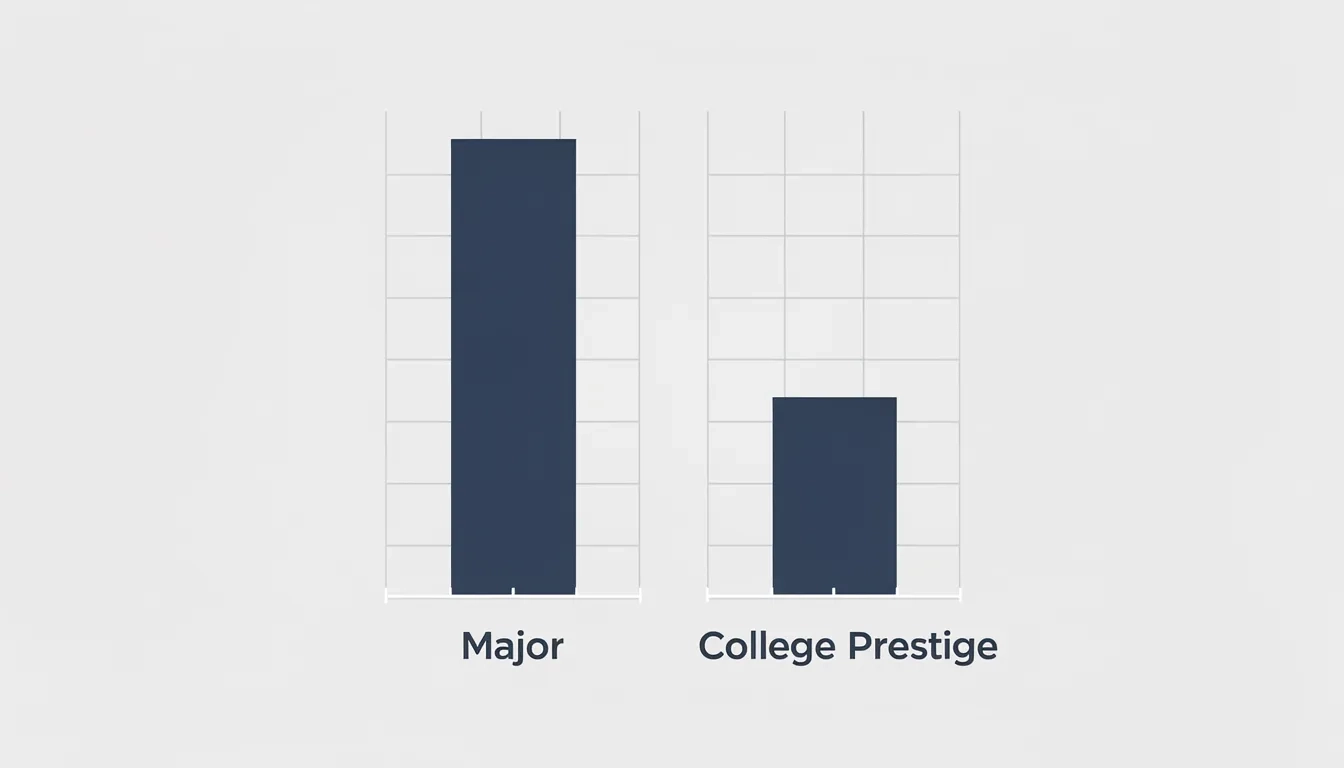
Here's a question worth $52,000 a year: does it matter more where you went to college, or what you studied there? Most families spend years obsessing over acceptance rates and campus rankings — the campus visits, the test prep, the whole machinery of admissions anxiety. But the research keeps pointing at something uncomfortable for that narrative. Your field of study creates earnings gaps that dwarf what school name alone can explain. The exceptions are real and worth knowing. For the average student, though, the answer is less murky than the college admissions industry would like you to believe.
The Numbers Don't Play Favorites
The Georgetown Center on Education and the Workforce published "The Major Payoff" in October 2025, tracking outcomes across 142 early-career and 152 prime-age bachelor's degree majors. The headline finding is hard to argue with.
Early-career graduates' median annual earnings range from $34,000 for communication disorders to $86,000 for computer science. That's a $52,000 annual gap that has nothing to do with which school put your name on a diploma.
Zoom out to prime-age workers (those between 25 and 54) and the spread widens further. Education and public service majors earn a median of $58,000 per year. STEM majors earn a median of $98,000. Within STEM, petroleum engineering tops out at $146,000 while miscellaneous agriculture sits at $64,000.
Compare that to the school prestige side of the equation. Payscale's 2024 College Salary Report shows MIT graduates earning a mid-career median of $196,900. Impressive. But MIT is also the most STEM-dense undergraduate institution in the country. The school premium and the major premium are tightly bundled in that figure — and when analysts try to separate them, most of the "MIT effect" turns out to be a "majors MIT students choose" effect.
The Study That Reshuffled the Debate
In 2002, economists Stacy Dale and Alan Krueger published a paper in The Quarterly Journal of Economics that quietly changed how researchers think about college selectivity. The question they posed: do elite schools cause higher earnings, or do they just admit people who would have done well regardless?
Their method controlled for something most prior studies missed. Rather than simply comparing graduates of selective and non-selective schools, they matched students who had applied to, and been accepted by, similar institutions — but chose to attend different ones. Someone who got into Georgetown but went to an in-state flagship. Someone who got into Duke but chose a regional school. Hold the ambition and academic ability constant, and the earnings premium from attending a more selective school largely disappears.
A follow-up study using Social Security Administration earnings data confirmed it. As the NBER summary put it: when you adjust for the type of students those schools attract, "estimates of the return to college selectivity fall substantially and are generally indistinguishable from zero."
One group is the consistent exception: Black and Hispanic students, and students from less-educated family backgrounds. For those groups, attending a selective institution still produced meaningful earnings gains even after controlling for student characteristics. The network access, the recruiting pipelines, the signaling effect — these provide real lift for first-generation students who don't otherwise have existing connections to professional networks. For a legacy admit from a wealthy family, the marginal value of the Yale name is genuinely small. For a first-generation student, it can be substantial.
When College Name Actually Moves the Needle
The research isn't arguing that prestige is worthless. It's showing that the benefit is narrower and more conditional than admissions marketing implies.
For STEM majors, institutional prestige has almost no measurable impact on earnings. Software engineering hiring runs on technical interviews, GitHub portfolios, and internship records. Recruiters at Amazon and Google screen candidates from hundreds of schools. The skill test replaces the credential.
The picture changes meaningfully for business and liberal arts graduates. Studies consistently find that prestige provides a real earnings boost for those graduates at selective institutions. Why? Because those fields lack hard skill proxies. A hiring manager can't hand a political science major a coding challenge, so the school's reputation fills in as a quality signal.
That same dynamic drives consulting and investment banking recruiting, where firms like McKinsey and Goldman Sachs maintain active "target school" lists that functionally exclude most non-elite campuses. That's the elephant in the room in most "where you go doesn't matter" takes — they're right for most fields, but finance and consulting don't play by those rules.
Research published in The Review of Higher Education found the pattern holds especially for women. For women who choose lucrative majors, the earnings gap with male peers disappears regardless of the institution they attended. Major choice overcame the prestige variable. For women without business or STEM degrees at elite schools, the pay gap persisted.
The Prestige-Major Interaction: A Framework
Here's how the relationship actually breaks down when you put field and institution together:
| Major Type | School Prestige Impact | Why |
|---|---|---|
| STEM (CS, engineering, nursing) | Low | Skills-based hiring; broad recruiting pipelines |
| Business / Finance | Moderate | Prestige used as a quality proxy; selective firm recruiting |
| Liberal arts / Humanities | High or nearly irrelevant | Elite school or graduate credentials provide the signal |
| Licensed professions (teaching, social work) | Almost none | Salaries set by pay scales; licensure matters more |
If you're majoring in STEM: the best school you can attend at a price that makes sense will generally outperform paying a large premium for prestige. The engineering curriculum at Purdue or Georgia Tech won't produce meaningfully different entry-level outcomes from Columbia's for most employers.
If you're targeting investment banking or management consulting specifically: school name matters here more than anywhere else. These industries still filter at the front door by campus, and knowing that before you enroll is useful.
If you're studying liberal arts and not planning on graduate school: the institutional brand does more work for you than it does for a STEM graduate. But it still doesn't override the major itself — a well-chosen practical focus within a liberal arts degree outperforms an undirected one at a prestigious school.
For everyone else, here's what matters more than the school's rank:
- Your major — the single biggest earnings lever you control as an undergraduate
- Internships and early work experience — employers weight practical experience heavily for entry-level hiring
- Whether the school's network serves your specific field — a mid-ranked engineering school with strong regional employer ties can outperform a famous liberal arts college for engineering placement
The Cost Calculation Nobody Does Honestly
Here's where both variables collide in a way that most families avoid confronting explicitly.
Georgetown CEW's data estimates that roughly 25% of bachelor's degree holders end up in majors where the undergraduate degree alone produces negative return on investment without additional graduate education. If you're paying $78,000 per year at a top private school to major in one of those fields, you are financing a decision that will almost certainly require another expensive degree before it pencils out.
The arithmetic is worth doing once. At a $40,000 annual premium between a top-50 private and an in-state flagship, you're spending $160,000 extra over four years. That same amount, invested at 7% annually over 30 years, grows to over $1.2 million. For a STEM major who will be hired based on skills regardless of institution, paying that premium is a genuinely costly choice.
This isn't an argument against elite schools across the board. It's an argument against letting prestige anxiety make a $160,000 decision without running the numbers first.
What Happens After the First Job
Most salary studies track outcomes 5–15 years post-graduation. Helpful, but incomplete.
Career switching is common. About a third of workers end up in roles unrelated to their undergraduate major. When that happens, employers weigh work history and demonstrated skills far more than undergraduate institution. A history major who spent five years building products at a tech company has a different story than a history major from a slightly more prestigious school who didn't.
Graduate school reshuffles things, too. For fields where the real credential is a professional degree — law, medicine, an MBA — undergraduate prestige matters primarily for admission to the next program. Law school admissions committees and MBA programs do factor in undergraduate institution. So the full sequence matters, not just any one step.
Inside Higher Ed's October 2025 reporting highlighted a wrinkle worth watching: since 2022, recent college graduates have faced higher unemployment than the general workforce. Computer science graduates had a 6.8% unemployment rate in 2022 despite strong mid-career salaries — a reminder that even a high-earning major doesn't guarantee a smooth start. Researchers noted: "The more specific the major, the more sensitive it is to sectoral shocks." Highly specialized degrees capture outsized gains when their industry is hot. They also take harder hits when that industry contracts.
Broad majors — business, economics, general engineering — tend to offer more adaptability across economic cycles. That flexibility has real long-run value that straight salary comparisons don't capture.
Bottom Line
My honest read of the data: for most students, your major matters more than your college name. The earnings gaps created by field of study are larger than those created by institutional prestige, across most career paths and most of the research.
But the exceptions carry real weight:
- First-generation students and students from lower-income families get a meaningful earnings and networking lift from selective schools — more than their wealthier peers do
- If you're targeting investment banking, management consulting, or a few other prestige-filtered industries, the school name matters and you should account for it explicitly
- Liberal arts and humanities majors who aren't headed to graduate school will find the institutional brand does more work for them than for a STEM graduate in the same position
Pick a major you'll actually pursue with some seriousness, in a field with real demand, at a school where the cost makes sense relative to expected outcomes. That decision beats chasing a ranking number, every time.
Frequently Asked Questions
Does the college name matter at all, or is the whole thing overrated?
College name matters, but the benefit is conditional. For STEM graduates, research finds it has minimal impact on earnings. For business and liberal arts graduates entering competitive recruiting pipelines, it matters more. For first-generation and low-income students, selective institutions appear to provide real earnings lift through network access and signaling. The mistake is treating prestige as universally valuable rather than field-specific.
What majors tend to have the best financial outcomes regardless of school?
Computer science, electrical engineering, nursing, finance, and accounting consistently show up at the top of early-career earnings data. Georgetown CEW's 2025 "Major Payoff" report found CS graduates earning a $86,000 median at entry level. Petroleum engineering leads at mid-career with a $146,000 median. The caveat: pairing a high-earning field with genuine aptitude matters — struggling through an engineering degree to chase a salary tends not to end well.
The Dale-Krueger study says elite schools don't boost earnings — is that really true?
Largely, yes — for students who already have strong academic profiles and existing access to professional networks. The study found that once you control for the type of student a selective school attracts, the earnings premium becomes statistically negligible. The notable exceptions are students from underrepresented minority backgrounds and those with less-educated parents, for whom the selective institution's network and signal appear to provide genuine additional earnings lift.
Should a first-generation student prioritize school prestige or major?
Both matter, but the priority depends on the specific path. Research suggests first-generation students capture more earnings value from selective institutions than their wealthier peers do. At the same time, major choice remains the most controllable earnings variable. When possible: target a selective school with a practical, high-demand major at a cost you can manage without unsustainable debt. If that combination isn't available, a marketable major at an affordable school often beats an expensive prestigious school with an undirected course of study.
What's the most common financial mistake in this decision?
Paying a large annual tuition premium to attend a prestigious school while studying a field that Georgetown CEW estimates requires graduate school to achieve positive return on investment. Roughly 25% of bachelor's degree holders are in that situation. Knowing which majors fall into that category before you enroll — and pricing in the likely cost of the graduate degree you'll need — is worth far more than a campus tour.
Does where you went to college matter more as you get older?
Generally, less. Within 10 years of graduation, work history and demonstrated skills outweigh undergraduate institution for most employers and roles. Graduate credentials, if you pursue them, also tend to reset the prestige signal. The exception is industries like investment banking and management consulting, where the initial door-opening effect of a target school can shape early career trajectory in ways that compound over time.
Sources
- The Major Payoff: Evaluating Earnings and Employment Outcomes Across Bachelor's Degrees - CEW Georgetown
- Top U.S. Colleges and Highest-Earning Majors Revealed in Payscale's 2024 College Salary Report
- Estimating the Return to College Selectivity over the Career Using Administrative Earnings Data - NBER
- Study Examines Impact of Major vs. Impact of College Prestige on Women's Earnings - Inside Higher Ed
- In "Rocky" Labor Market, Your College Major Matters - Inside Higher Ed