Is College Worth It? A Data-Driven Look at College ROI
The median college graduate earns a 12.5% annual return on their educational investment, per April 2025 research from the Federal Reserve Bank of New York. That beats the historical stock market average by about four percentage points. And yet a recent NBC News poll found 63% of registered voters think a four-year degree isn't worth the cost, up from just 40% in 2013. Both things can be true simultaneously. The degree still pays off for most graduates. But "most" conceals a distribution that includes millions of students enrolled in programs where they'd be better off financially never having started. The real question isn't whether college is worth it in the abstract. It's whether this specific program, at this school, for this price, makes sense for you.
Why the Average Number Misleads
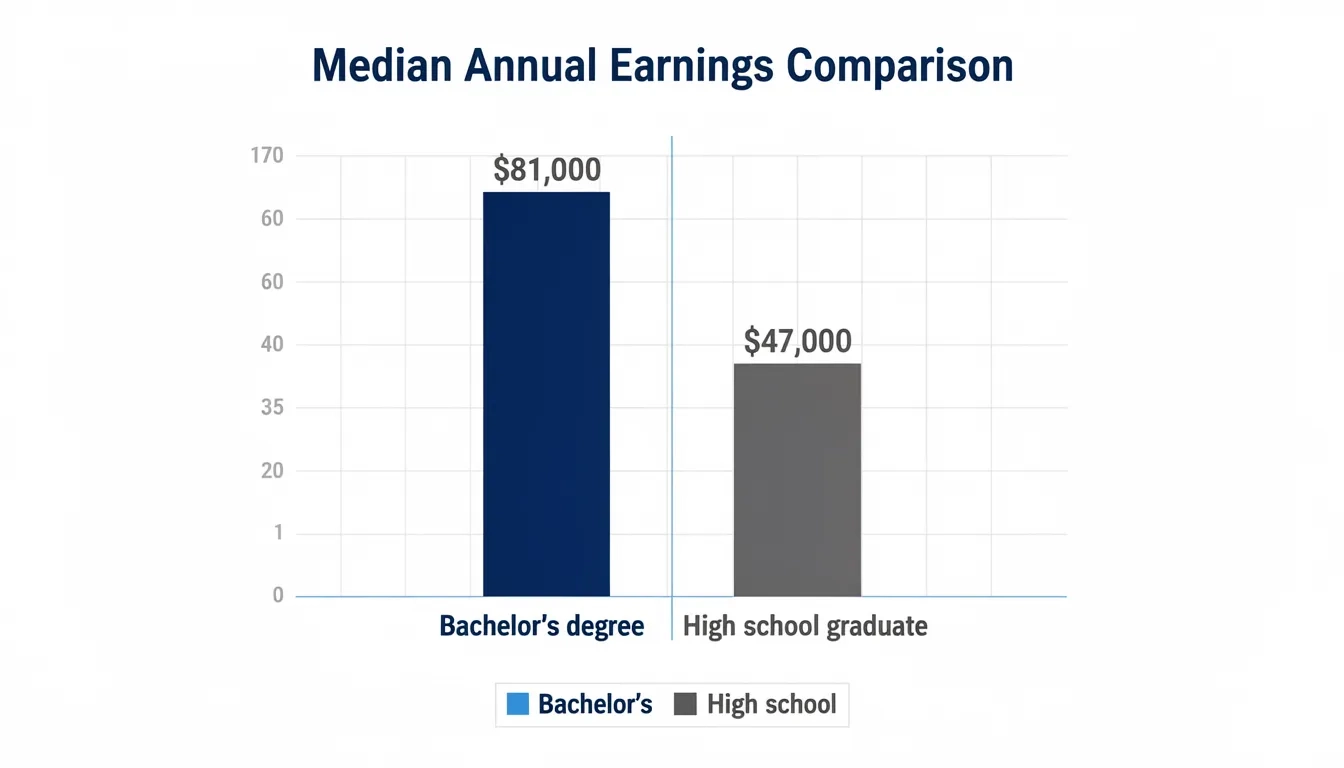
Prime-age bachelor's degree holders earn a median $81,000 per year, compared to about $47,000 for high school graduates — a 70% earnings premium, per Georgetown's Center on Education and the Workforce. Unemployment follows the same pattern: 2.9% for degree holders versus 6.2% for those without one.
But averages are the enemy of sound financial decisions here.
Georgetown CEW ranked 4,600 colleges in their 2025 ROI report and found that graduation rate is the single strongest predictor of institutional ROI, with correlations reaching 0.65 at bachelor's-granting schools. Not prestige. Not tuition cost. Graduation rate. A school where 30% of students finish doesn't give the other 70% a partial credential. It gives them debt with no degree.
The FREOPP research institute analyzed 53,000 degree and certificate programs nationwide and found 31% of current students are enrolled in programs with negative lifetime ROI. One in three. The earnings premium activates only at completion, in a field with sufficient wages, at a price that leaves room to recoup the investment. If any of those conditions fail, the math can flip quickly.
What Actually Drives Your Return
College ROI isn't a fixed number you look up once. It's the output of three variables that are at least partially within your control:
- What you study: by far the highest-impact factor
- What you actually pay: net price after all grants and aid, not the brochure figure
- How long it takes: every extra semester compounds costs while delaying your earnings clock
The Federal Reserve estimates the total cost of a typical four-year degree at around $180,000 in 2024. That's not just tuition. It bundles actual out-of-pocket expenses with opportunity cost (what you would have earned working instead). At $18/hour full-time, forgone wages run $37,440 per year — roughly $150,000 over four years that never appears on a bursar statement but absolutely belongs in your financial model.
The degree premium only kicks in at completion. Three years of tuition with no credential mostly captures the cost side of the ledger without the benefit.
Time-to-graduate is the most underrated variable. Georgetown's 2025 data puts ROI at roughly 9.3% for five-year graduates, dropping to just over 7% for six-year completers. A broad stock index has historically returned around 8%. Taking two extra years to finish may erase the financial case entirely for students in lower-earning fields.
Major Choice: The Decision That Outweighs Everything Else
My take here is clear: picking your major is a more consequential financial decision than picking your school — for most students, in most situations. The data is unambiguous on this.
Georgetown CEW's "The Major Payoff" report, released October 2025, documented median earnings ranging from $64,000 for miscellaneous agriculture graduates to $146,000 for petroleum engineers. Both are technically STEM fields. FREOPP's program-level analysis fills in the lifetime ROI picture:
| Field | Median Lifetime ROI |
|---|---|
| Engineering | $949,000 |
| Computer Science | $652,000 |
| Nursing | $619,000 |
| Economics | $549,000 |
| Biology (without graduate school) | Low to marginal |
| Education (bachelor's) | Often negative |
| Fine Arts / General Liberal Arts | Negative |
Education is a striking data point. Teachers provide clear social value, but when you run the financial math — comparing median teacher salaries against entering the workforce at 18 — bachelor's degrees in education frequently generate negative lifetime ROI. The salary scales simply don't recoup the full four-year investment.
The STEM premium is real but not uniform. Georgetown's analysis found STEM concentration correlates with institutional ROI at only 0.40–0.51, meaningful but weaker than most families assume. A computer science degree from a school with a 35% graduation rate can easily underperform a business degree from a school that reliably gets students across the finish line.
Worth naming directly: psychology, biology, and English rank among the most popular undergraduate majors in the country. All three tend to land in the lower-returning tier when measured on earnings alone. Choosing those fields isn't a mistake. It's a trade that deserves to be conscious rather than accidental.
Net Price vs. Sticker Price
Here's where most families go wrong from the start: evaluating college cost using sticker price, which is almost never what students actually pay.
For public four-year schools in 2025-26, average net tuition after grants and aid is $2,300 per year. For private nonprofit schools, it's $16,910. Neither looks anything like the $55,000–$65,000 figures that dominate news coverage. College Board data shows net tuition at public universities has dropped nearly 50% in real terms over the past decade.
More than half of public university graduates now finish with zero student loan debt. Among those who do borrow, the average balance is $27,420 — significant, but the six-figure debt crisis narrative applies to graduate and professional school borrowers, not the typical bachelor's student.
The counterintuitive reality: students from lower-income families often find selective private schools cheaper than their state flagship, because well-endowed private schools distribute far more need-based aid. A family earning under roughly $75,000 per year accepted to both their state school and a selective private should compare actual aid offers before assuming the cheaper-looking option actually is.
Regional public universities consistently punch above their weight on ROI. Georgetown CEW's analysis flags them as reliable value plays: lower net tuition, solid graduation rates, and strong regional employer pipelines. They're systematically underrated by families chasing prestige.
When the Bachelor's Degree Is the Wrong Tool
The higher education industry doesn't love talking about this: for some fields and some students, a certificate or associate's degree produces a better financial outcome than a four-year program. Full stop.
Georgetown CEW's 2025 data shows short-credential programs matching or beating bachelor's degrees at 10- and 20-year ROI horizons. The structural reason is simple: lower upfront cost and faster workforce entry. FREOPP found technical trades certificates average $313,000 in lifetime ROI. Health profession associate's degrees average $224,000. Both beat the $160,000 median for completion-adjusted bachelor's degrees.
The bachelor's does eventually pull ahead, at the 30-40 year mark, as the compounding earnings premium accumulates. But that's a long horizon to bet on, and between 2018 and 2022, FREOPP calculated that approximately $122 billion in federal funding — including Pell grants and student loans — flowed into programs with negative ROI. That's public money financing outcomes that leave students worse off than the alternative.
Dental hygiene, radiologic technology, cybersecurity, and skilled trades frequently produce comparable or superior earnings to many bachelor's degree fields in half the time, with a fraction of the debt. The caveat: many career tracks require the bachelor's as a non-negotiable credential regardless of what the financial math says. Knowing whether you're in one of those tracks — or whether the degree is genuinely optional for your goal — is worth clarifying before you commit to four years.
How to Run the Numbers Before You Commit
Most families spend more time researching a car purchase than modeling a $200,000+ educational decision. Here's a five-step framework that takes about an hour and catches most of the expensive mistakes.
Step 1: Get the real net price. Use the Net Price Calculator required on every school's website after filing your FAFSA. Multiply by your expected years to graduate. Use 4.5 if you're being honest with yourself about how these things typically go.
Step 2: Add opportunity cost. Estimate what you'd realistically earn working full-time without the degree in your region. This number belongs in the model even when it feels hypothetical. It's not.
Step 3: Look up field-specific earnings. The Bureau of Labor Statistics Occupational Outlook Handbook gives current median wages by occupation. Georgetown CEW's Major Payoff tool shows earnings at the 25th and 75th percentiles — if you don't know how you'll rank in a competitive field, don't default to the median.
Step 4: Find your break-even. For a typical bachelor's degree, break-even arrives around 12 years of post-graduation work. Engineering and CS graduates often hit it in 7-8 years. Education and fine arts majors may never fully get there.
Step 5: Run the pessimistic scenario. What if graduation takes five years? What if you start at $43,000 instead of the field median? What if you're carrying $32,000 in loans at 6.5%? If the investment still works under pressure, it's probably sound. If it only pencils out under ideal conditions, that's a risk worth naming before anyone signs anything.
Bottom Line
- Major selection is the most important financial variable in a college career, often more impactful than choosing between schools. Engineering, CS, nursing, and economics return dramatically more over a lifetime than education, fine arts, or general liberal arts.
- Net price is the only cost figure that matters. Most public university students pay well under $10,000 per year after grants. Elite private schools often cost lower-income families less than their state flagship.
- Graduation rate predicts ROI better than prestige. A school where 65% of students graduate will typically beat one where 35% do, regardless of rankings.
- Run the five-step model before committing. Real net price times years to graduation, plus opportunity cost, compared against your field's 25th percentile earnings — not the median. Stress-test the slow scenario.
- Short-credential programs deserve serious consideration. Technical trades certificates average $313,000 in lifetime ROI, ahead of the median bachelor's degree. For fields where a four-year degree isn't required, that math matters.
Frequently Asked Questions
Is a college degree still worth it in 2025?
For most graduates, yes. The Federal Reserve Bank of New York's April 2025 research puts the median annual return at 12.5%, higher than historical stock market returns. But roughly 31% of students are enrolled in programs that produce negative lifetime ROI, so the answer turns heavily on field of study, completion, and the price actually paid.
Which college majors have the best return on investment?
Engineering, computer science, nursing, and economics consistently rank at the top, with lifetime ROIs ranging from $549,000 to $949,000 according to FREOPP's analysis of 53,000 programs. The highest returns tend to cluster in fields combining strong starting salaries with low unemployment rates and clear hiring pipelines.
Does the school you choose matter financially?
Less than most families think. Georgetown CEW's 2025 analysis found graduation rate predicts ROI more strongly than school prestige or sticker price. An in-state public school with strong completion rates regularly outperforms a name-brand private school with poor retention numbers for certain demographics.
Is it a myth that student debt is out of control?
Partly. The median debt at graduation for bachelor's students who borrow is $27,420, and more than half of public university graduates leave with zero debt. The crisis narrative is real, but it's concentrated among graduate and professional school borrowers and students who attended expensive schools for low-earning fields — not the typical four-year student.
Can a trade certificate outperform a bachelor's degree financially?
Often yes, especially in the short and medium term. Technical trades certificates average $313,000 in lifetime ROI versus $160,000 for the median bachelor's degree, largely because of lower costs and faster workforce entry. The bachelor's advantage compounds at the 30–40 year mark, but for any field where the four-year credential isn't required, the shorter path can win on the numbers.
What's the fastest way to reduce my college debt risk?
Choose a field before choosing a school, not the reverse. Look up the 25th percentile starting salary for your intended occupation and calculate whether your expected loan payments (if any) stay under 10% of that take-home figure. If they don't, either the school is too expensive for that field, or the field's earning potential needs a second look.
Sources
- Ranking 4,600 Colleges by ROI (2025) - Georgetown CEW
- The Major Payoff: Evaluating Earnings Across Bachelor's Degrees - Georgetown CEW
- Federal Reserve: College Is Still Worth the Investment for Most Students - CNBC
- Does College Pay Off? A Comprehensive ROI Analysis - FREOPP
- New College Board Data Show Tuition and Debt Lower Than a Decade Ago - APLU