Colleges for Students with Learning Disabilities: A Real Guide
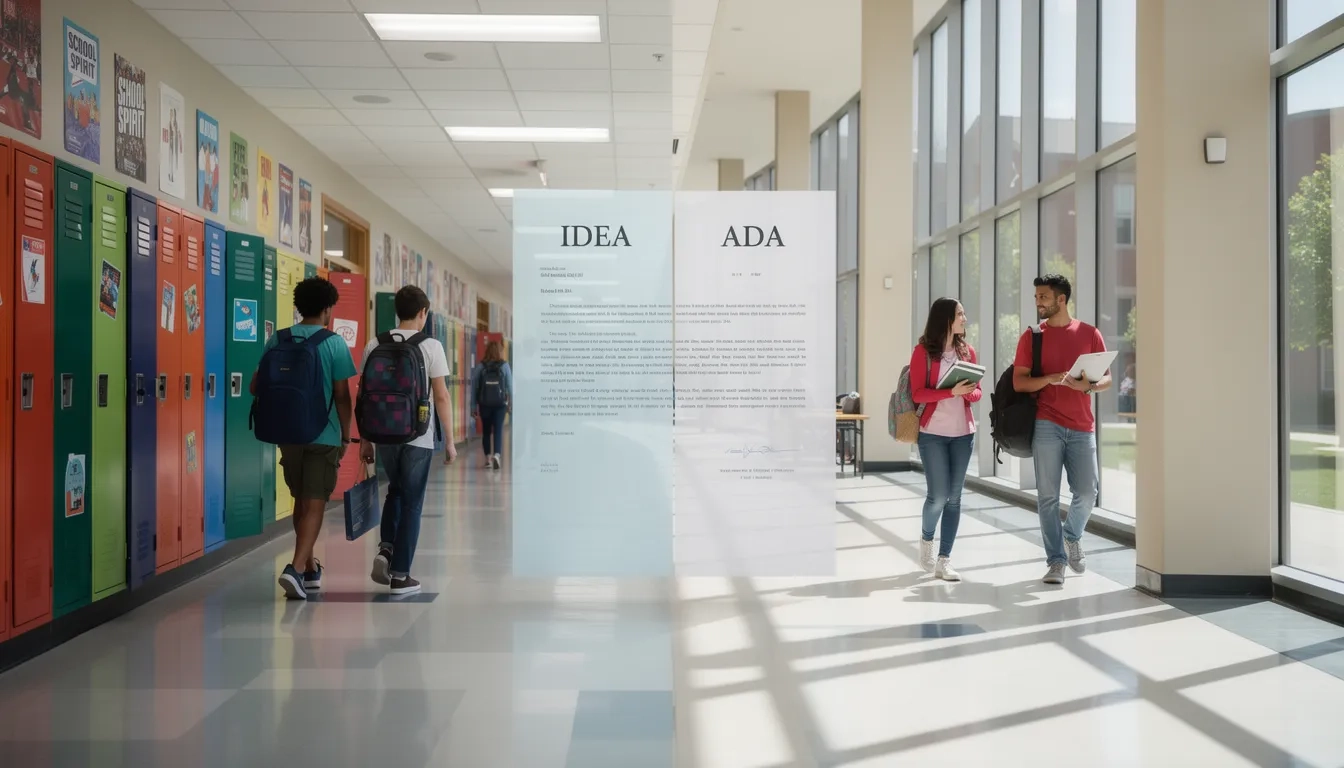
When students with learning disabilities enter college, the biggest shock usually isn't the academics. It's discovering that the system that protected them for thirteen years has vanished. That IEP? Gone. The case manager who made sure teachers followed accommodations? Gone. The legal mandate requiring the school to find and serve you? Also gone.
This shift is real, and families consistently underestimate it. Choosing the right college as a student with a learning disability is less about prestige and more about infrastructure — specifically, whether the school's support system matches the actual way that student's brain works.
The Law Changes Completely When You Graduate High School
In K-12, schools are governed by IDEA (the Individuals with Disabilities Education Act), which requires them to identify students with disabilities and provide services. Colleges operate under a different law entirely: the Americans with Disabilities Act and Section 504 of the Rehabilitation Act of 1973.
Under college law, the burden shifts to the student. Colleges must provide "reasonable accommodations" — but only when students proactively disclose their disability, submit documentation, and request specific help. The school doesn't come looking for you.
About 19% of undergraduate students have some form of disability, according to the ADA National Network. Yet a significant number never register with disability services, which means they receive nothing. The system is opt-in by design.
What colleges must provide once you register:
- Extended time on tests (commonly 1.5x or 2x)
- Quiet or separate testing environments
- Lecture recording access or note-taking assistance
- Text-to-speech and other assistive technology
- Alternative format materials (digital texts, large print)
What they are not required to do: lower academic standards, waive graduation requirements, or guarantee tutors or one-on-one instruction. "Reasonable accommodations" is a narrower term than it sounds.
The Documentation Gap Nobody Warns You About
Here's a practical problem that blindsides a lot of families. Many students arrive at college with psychoeducational evaluations completed in middle school. Colleges frequently reject these.
Most disability offices require evaluations within the last three to five years. If your documentation is older, the office may deny accommodations or limit what they'll grant until you get re-tested. A current full psychoeducational evaluation from a licensed psychologist typically runs between $1,200 and $3,500 depending on the provider and your location.
The practical move: schedule updated testing during junior year of high school if your existing evaluation is aging out. Don't wait until after admission, when the spring rush for evaluations hits and appointments back up by months.
Not All Disability Services Are the Same — Not Even Close
This is the assumption that gets families into trouble. Because every accredited college must comply with the ADA, many assume support quality is roughly uniform. It is not.
Think of college disability support in three tiers:
| Tier | What It Looks Like | Typical Cost |
|---|---|---|
| Basic Compliance | Standard accommodations office, minimal staff, no proactive outreach | Included in tuition |
| Enhanced Services | Dedicated advisors, peer coaching, academic workshops, structured check-ins | Included or small fee |
| Specialized LD Programs | Fee-based programs with weekly coaching, executive function support, individual learning specialists | $1,000–$6,000+ per year extra |
The gap between a Tier 1 school and a Tier 3 program isn't cosmetic. It's the difference between having a letter on file that gives you extra time, and having a specialist who knows your academic history and meets with you weekly to adjust strategy.
Schools with Programs Built Specifically for LD Students
A handful of institutions have built infrastructure that genuinely goes beyond compliance.
Landmark College in Putney, Vermont is the most well-known specialized option. It's the only accredited four-year institution in the country designed entirely for students who learn differently — including those with dyslexia, ADHD, and autism spectrum conditions. Their student-to-faculty ratio sits at 6:1, meaning instruction is intensive and individualized by design, not as an accommodation. It's not cheap, and it's small (around 550 students), but the academic culture is built from the ground up around neurodiverse learners.
Beacon College in Leesburg, Florida holds another distinct distinction: it was the first accredited institution in the country to award bachelor's degrees exclusively to students with learning disabilities. Like Landmark, it combines small class sizes with life coaching, occupational therapy integration, and personalized instruction.
The SALT Center at the University of Arizona represents a different model — and arguably a more replicable one. It's a fee-based program embedded inside a large public research university. Students access intensive LD support (weekly sessions with support specialists, certified tutors, psychological services, workshops on time management and academic strategy) while also having access to 300+ majors, Division I athletics, and a full campus life. Importantly, SALT doesn't run "special classes" that signal difference to peers. The support is private and individualized.
Curry College's Program for Advancement of Learning (PAL) in Massachusetts has operated since 1970, making it one of the longest-running programs of its kind. It focuses on language-based learning differences like dyslexia and serves students through weekly sessions with learning specialists who function more as coaches than tutors.
Marist College has quietly built one of the stronger track records in this space. Their disability support program has been running since 1980, students with disabilities make up about 10% of enrollment, and the school reports an 80% graduation rate for that population — a number worth paying attention to when most schools don't publish this data at all.
Northeastern University's Learning Disabilities Program (LDP) pairs undergraduates with professional learning specialists for weekly one-on-one sessions. The focus is academic strategy — how to approach reading-heavy courses, how to structure study sessions, how to manage executive function across a full course load — rather than subject-specific tutoring.
The Questions You Should Ask on Every Campus Visit
Most families evaluate disability programs by reading the admissions website. That's exactly backwards. What matters is operational reality, and the only way to access it is by asking direct questions to actual staff.
Ask about staffing:
- How many full-time learning disability specialists are on staff (separate from general disability services)?
- What is the typical caseload per specialist?
- Is there a waitlist for services at the start of each semester?
Ask about program structure:
- Do students meet with a specialist weekly, biweekly, or only when they schedule it themselves?
- Does the program build academic strategy, or does it primarily provide content tutoring?
- Is executive function coaching (planning, initiating tasks, managing time) part of the program?
Ask about outcomes:
- What is the four-year graduation rate for students enrolled in your LD program compared to the general student population?
- How does the program shift support structure as students progress from freshman to senior year?
That last question cuts to something important. The best programs are designed to build independence progressively — more intensive support in year one, gradual reduction in scaffolding as students internalize strategies. Programs that keep students at the same level of dependency throughout four years aren't doing their job.
The goal of a good LD program isn't to make college easier. It's to make you better at doing hard things.
The Self-Advocacy Reality Check
Here's the thing that doesn't appear in any brochure: the single biggest predictor of college success for students with learning disabilities isn't program quality. It's whether the student arrives knowing how to advocate for themselves.
A student who schedules their own appointments, explains their learning profile clearly to a professor, and seeks help before a crisis hits will outperform a passive student at a far more supportive institution. Think College, the national organization that has tracked higher education inclusion programs since 2010, has consistently found that students who practice self-advocacy before college start access services earlier and sustain that access throughout their enrollment.
The practical move for students in 11th grade: start practicing now. Have your student call the disability services office at their current school and ask questions independently. Have them request their own SAT accommodations through the College Board rather than having a parent do it. Low-stakes practice in familiar environments builds muscle memory for the much higher-stakes situations ahead.
If a student can't explain their learning profile to an adult in a clear two-minute conversation, that's a skill to develop before move-in day — not after.
How to Actually Make the Decision
Most college search frameworks treat disability services as a checkbox rather than a core selection criterion. For students with significant learning disabilities, that's the wrong approach. Build the search around support first.
- Identify your primary challenge. Reading speed, working memory, executive function, and processing speed all require different program strengths. Know which one dominates before you research programs.
- Be honest about support intensity needed. Students who managed well in high school with minimal accommodations may thrive at a Tier 1 school. Students who needed daily structure may genuinely require a Tier 2 or Tier 3 program.
- Contact disability services before you apply. Call the office, not admissions. Ask about documentation requirements, fee-based options, and waitlists. The response — and the responsiveness itself — tells you something.
- Visit the office unannounced. Show up on a campus tour and walk into disability services without an appointment. Are staff available? Friendly? Knowledgeable? Or defensive and overextended?
- Price it honestly. Add program fees to every school's total cost. A school that costs $8,000 less per year but runs a bare-minimum accommodations office may cost more in extended enrollment, dropped courses, or lost merit scholarships.
One counterintuitive point worth making directly: a $4,500-per-year fee-based LD program at a mid-ranked school will often produce better outcomes than a 504 letter at an elite university with a two-person accommodations office. Prestige doesn't compensate for absent infrastructure.
Bottom Line
Finding the right college as a student with a learning disability requires reframing the search entirely. You're not just picking a school — you're picking a support system that will either help you build independence or leave you to figure it out alone.
- Update documentation in 11th grade. Don't wait until after acceptance to discover your evaluation is too old.
- Tier 3 programs cost extra and are worth budgeting for. Add program fees to financial comparisons as a real line item.
- Ask hard operational questions on visits. Staff-to-student ratios and graduation rate comparisons reveal more than any website.
- Build self-advocacy skills before arrival. The best program in the country can't help a student who waits passively for support to find them.
Schools like Landmark College, Beacon College, the University of Arizona SALT Center, Curry College PAL, and Marist College have each built something real — programs grounded in the assumption that students who learn differently need strategy and skilled coaching, not just extra time on a test.
Frequently Asked Questions
Do IEPs and 504 plans from high school transfer to college?
No. IEPs are governed by IDEA, which applies only to K-12 education. A high school 504 plan doesn't automatically carry over either. In college, you register separately with the disability services office, submit current documentation, and request accommodations through that office. The process starts fresh at every school.
What's the actual difference between a disability services office and a fee-based LD program?
Every accredited college must have a disability services office, which grants legally required accommodations (extended test time, alternative formats) at no additional charge. Fee-based programs are supplemental: they typically offer weekly coaching sessions, individualized academic strategy development, executive function support, and dedicated learning specialists. Think of the baseline office as your legal floor and a fee-based program as an active investment in outcomes.
Do colleges have to accept any documentation I bring?
No. Colleges set their own documentation standards. Most require evaluations conducted within the last three to five years by a licensed psychologist or educational diagnostician. Older evaluations may be rejected or result in limited accommodations. Contact the disability services office before applying to confirm what they require.
Is Landmark College the best choice for every student with a learning disability?
Landmark is genuinely exceptional for students who need intensive, structured support and who will thrive in a smaller community built entirely around neurodiverse learners. But students who want access to a large university, a wide range of majors, or Division I sports often do better in embedded programs like SALT at the University of Arizona, where specialized support coexists with a full campus experience. The right fit depends on the individual's academic profile and social needs.
Can students with ADHD access learning disability programs?
Yes. Most college LD programs serve students with ADHD alongside those with dyslexia, dyscalculia, and other learning differences. ADHD is recognized under the ADA as a condition that may substantially limit learning and thus qualifies for accommodations. Programs specifically built around executive function — like Adelphi University's Learning Resource Program — can be especially well-matched for ADHD students.
When in the college search process should families start thinking about disability support?
Earlier than feels necessary. Students who begin the college search with disability programs as a primary filter (not an afterthought) in spring of junior year can evaluate documentation requirements, waitlists, and fee-based program options before paying application fees. Contacting disability offices directly during junior year visits gives you ground-level intelligence that admissions tours simply won't surface.
Sources
- Rights and Responsibilities of College Students with Learning Disabilities - LDA America
- Research Brief: Higher Education and the ADA - ADA National Network
- College Programs for Students With Intellectual Disabilities - BestColleges
- SALT Center at the University of Arizona
- Best Colleges for Students with Disabilities - Appily
- US Colleges with Learning Disability Programs - LDRFA