Colleges That Accept Homeschool Students: A Complete Guide
The numbers catch most people off guard. Homeschooled students get accepted to college at an 87% rate — compared to 68% for public school graduates, according to the National Home Education Research Institute. So the worry that homeschooling closes doors to higher education isn't just unfounded. It's backwards.
The real challenge isn't getting in. It's knowing which colleges make the process straightforward, which ones need extra documentation, and how to present an unconventional education in a way admissions offices can actually work with.
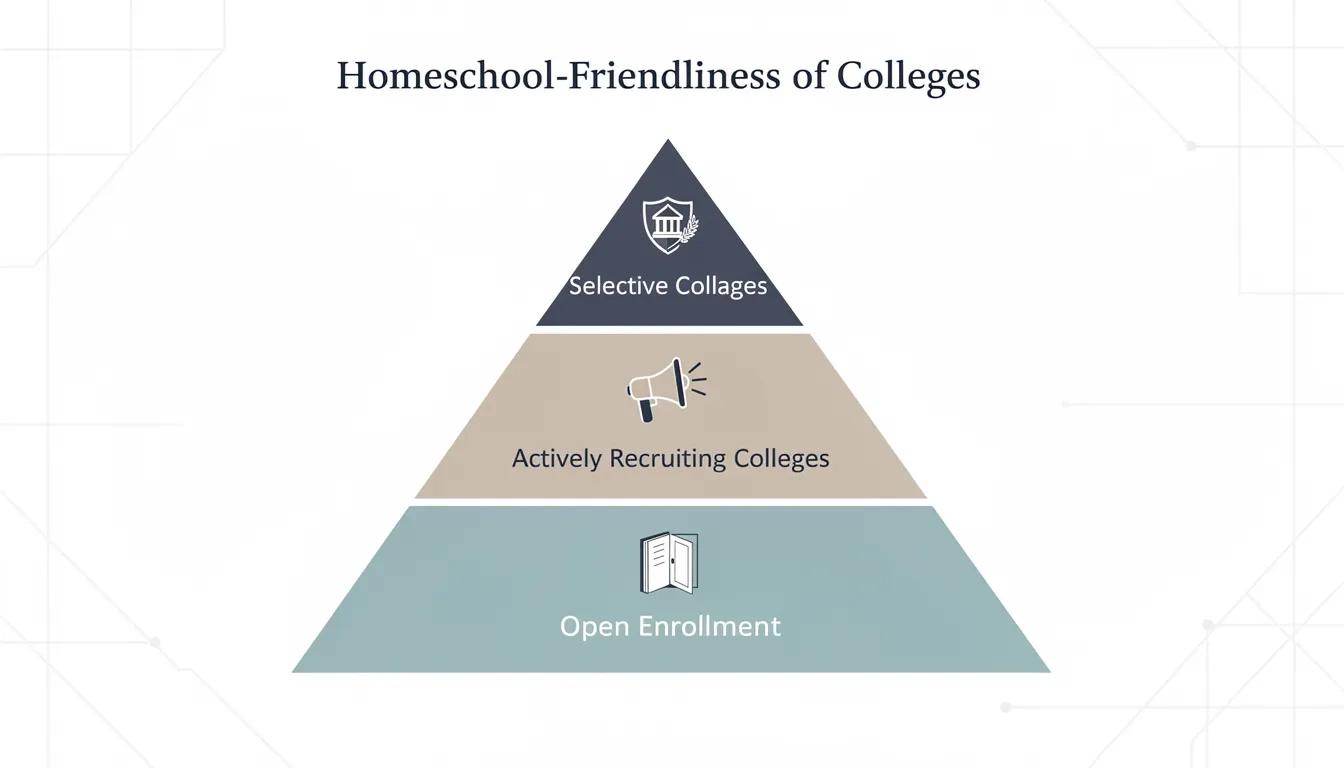
The Three Tiers of Homeschool-Friendly Colleges
Not all colleges handle homeschool applications the same way. Think of them in three broad categories:
| Tier | Who They Are | Admission Style |
|---|---|---|
| Open Enrollment | Community colleges + 413 accredited 4-year schools | Accept all HS graduates; no GPA or test minimums |
| Actively Welcoming | Liberty, Cedarville, Dallas Baptist, Grove City | Recruit homeschoolers; flexible on documentation |
| Selective With Homeschool Policies | MIT, Stanford, UVA, UNC | Standard review; specific homeschool guidelines apply |
The tier you target should match your goals, your documentation, and your timeline. And sometimes the smartest move is starting in a lower tier and transferring up after a year or two.
Open Enrollment Colleges: The Easiest Entry Points
This is the part of the story that rarely gets told. According to Homeschooling for College Credit, 1,580 accredited colleges and universities in the United States offer open enrollment to anyone who has a high school diploma — homeschool included. That figure includes 1,167 public community colleges where open enrollment is essentially the default.
Open enrollment means the college doesn't reject applicants based on academic competitiveness. No minimum GPA. No SAT cutoff. Your transcript is reviewed to confirm you graduated, not to judge whether your courses were rigorous enough.
Three 4-year institutions deserve particular attention here. Thomas Edison State University (Trenton, NJ), Excelsior University (Albany, NY), and Charter Oak State College (New Britain, CT) were all built for non-traditional learners. All three accept massive amounts of prior learning credit — through CLEP exams, AP scores, or dual enrollment classes — and students can often arrive with enough credits to finish a bachelor's degree in under two years.
If you spent high school taking dual enrollment courses at a local community college (a path popular in homeschool communities for good reason), these schools can cut degree costs dramatically. You're not starting from zero. You're converting credits you already earned.
The stigma around open enrollment schools isn't entirely deserved, either. Thomas Edison State in particular has strong programs in nursing, business, and technology, and its accreditation is fully regional — the same kind that covers flagship state universities.
4-Year Colleges That Actively Recruit Homeschoolers
Beyond open enrollment, a specific cluster of 4-year schools doesn't just tolerate homeschool applicants. They seek them out.
Cedarville University in Ohio sits near the top of this list. About 22% of Cedarville's student body consists of homeschool graduates. That's not a coincidence — the school has built advising infrastructure specifically for homeschoolers, and admissions staff have seen enough non-traditional applications to evaluate them fairly and quickly.
Liberty University in Virginia is consistently described by homeschool families as frictionless. Large enrollment, flexible documentation requirements, and robust online programs make it accessible regardless of how you structured your high school years. Their admissions team fields homeschool applications regularly and knows what to do with them.
Dallas Baptist University in Texas goes a step further: they explicitly accept the CLT (Classic Learning Test) as an alternative to the SAT or ACT. That's significant, because the CLT is specifically popular among homeschool families and is now accepted by more than 300 colleges nationwide. DBU's admissions staff is known for working directly with families to resolve documentation questions rather than routing them through generic processes.
New College Franklin in Tennessee has a student body where homeschool graduates aren't the exception. The curriculum mirrors Socratic, discussion-based learning that many homeschool families already practice, so the academic transition tends to feel natural rather than jarring.
Grove City College in Pennsylvania has a long track record with homeschoolers and is regularly cited in community forums as genuinely easy to work with. Their team has processed enough non-traditional transcripts to have built a real internal review system for them.
What You Actually Need to Apply
This is where homeschool applicants sometimes stumble — not because the requirements are unreasonable, but because nobody lays them out clearly.
Most colleges expect these documents from homeschool applicants:
- A homeschool transcript (course titles, descriptions, grades, credit hours, and graduation date)
- A curriculum summary listing textbooks used, syllabi where available, and any outside instructors
- Standardized test scores, or a portfolio of work if the school is test-optional
- Letters of recommendation from adults outside the immediate family
- A personal essay, sometimes with a supplemental form about your educational background
The transcript is the biggest sticking point for most families. You generate it yourself. No outside institution signs off on it. That sounds daunting, but experienced admissions officers have reviewed hundreds of parent-created transcripts. What they want is clarity — course titles that make sense, a grade scale with an explanation, and a coherent picture of four years of work.
Letters of recommendation don't need to come from traditional classroom teachers. Co-op instructors, tutors, community college professors, coaches, employers, and mentors all work. Often they're more relevant than a classroom teacher would be anyway, because they've seen the student in environments that reflect real initiative.
One advantage that doesn't get mentioned enough: personal essays. The typical applicant pool has thousands of essays about the same handful of experiences. A homeschooler who spent two years studying marine biology along the Gulf Coast, or who ran a small landscaping business while completing coursework, has genuinely unusual material. Admissions readers notice difference. It's rare enough that it gets remembered.
How Selective Colleges Think About Homeschoolers
Yes, selective colleges accept homeschoolers. The process requires more preparation, but the door isn't closed.
Harvard allows families to create their own transcripts and has no official test mandate. It's test-optional. The challenge isn't the format of your documentation. It's that Harvard is Harvard — the same extraordinary achievement bar applies to every applicant, regardless of educational background.
MIT advises homeschoolers to demonstrate academic engagement through external channels: AP exams, community college coursework, summer research programs, math competitions. These give admissions readers independent data points they can verify.
Stanford asks for a detailed curriculum description — not just course titles, but the reasoning behind the educational approach. Why was this method chosen? How was learning evaluated? Stanford's team is looking for intentionality, not a specific format.
The University of Virginia evaluates academic performance within the homeschool curriculum itself, rather than forcing it into a traditional GPA conversion. UVA also specifically encourages community involvement as evidence of engagement beyond the household.
The external verification piece is what distinguishes successful selective applicants. AP scores, CLT results, college transcripts, competition placements — these are independent data points that admissions offices can trust precisely because the student didn't generate them.
Think of it this way: your parent-created transcript is your account of what happened. External credentials are corroborating evidence. Selective schools need both.
The Community College Pathway: Underused and Underrated
Here's my honest take: for homeschool students who aren't sure which four-year school to attend, or whose documentation isn't fully sorted out, starting at a community college is one of the smartest available moves.
Community colleges have open enrollment by definition. No GPA minimum, no test score requirement, no homeschool documentation review beyond confirming graduation. You finish your program, apply, and show up. The process takes less than an afternoon.
After two semesters, you have a real institutional GPA on a real college transcript. Transfer applications become dramatically simpler because you're now evaluated as a college student, full stop — not as a homeschool graduate whose academic preparation needs to be inferred. Arizona State University has entire transfer scholarship programs designed around exactly this pathway.
The financial picture is compelling too. Community college tuition typically runs between $3,440 and $4,900 per year for in-state students. Completing your first two years there and transferring to a four-year institution can save $40,000 or more off total degree costs, without changing the diploma you graduate with.
There's a social dimension that often goes unmentioned. Community colleges tend to have a higher proportion of non-traditional students, which makes the environment more welcoming for someone whose educational background doesn't follow the standard path. You're not the only one who got there a different way.
Building Your College List: A Practical Framework
When building a college list as a homeschooler, start with a few honest questions:
Step 1 — What kind of admission do I need?
- Guaranteed admission with minimal paperwork → open enrollment schools and community colleges
- A welcoming 4-year environment where homeschoolers are common → Cedarville, Liberty, DBU, Grove City, New College Franklin
- Selective admission at a nationally recognized institution → build external credentials first
Step 2 — Call each school's admissions office and ask three things:
- Do you accept parent-generated transcripts, or do you require a notarized document?
- Do you accept CLT scores in place of SAT/ACT?
- Is there a homeschool-specific supplemental form?
Schools experienced with homeschool applicants answer these questions quickly and confidently. Schools that transfer you around or give vague answers are telling you something useful: they don't see many homeschool applications, and your file may get an inconsistent review.
Step 3 — Start in the spring of 11th grade, not the fall of senior year. That window gives you time to evaluate financial aid policies before spending money on application fees, complete test preparation without compressing it into a busy senior fall, and track down letters of recommendation from outside instructors who may be harder to reach later.
Students who begin list-building in spring of junior year can also visit campuses, attend homeschool-specific college fairs (several states host them annually), and request fee waivers in advance of deadlines.
Bottom Line
- Homeschool students get accepted to college at higher rates than public school graduates (87% vs. 68%), so approach this process with confidence, not anxiety.
- For guaranteed admission with minimal friction, target the 1,167 open enrollment community colleges or the 413 open enrollment 4-year schools. Thomas Edison State University, Excelsior University, and Charter Oak State College are especially well-suited to homeschool graduates with prior college credits.
- For a welcoming 4-year environment, Cedarville University, Dallas Baptist University, Liberty University, Grove City College, and New College Franklin have built genuine infrastructure for homeschool students and see them regularly.
- For selective admissions, generate external credentials — AP scores, CLT results, college transcripts, competition results — that give admissions offices independent data they can verify alongside your parent-created transcript.
- Start in spring of junior year and call admissions offices directly with the three questions above. You'll know within five minutes whether a school is prepared to work with you.
The data has never been working against homeschoolers in college admissions. The families who struggle are usually the ones who didn't document their work carefully — not homeschoolers as a group.
Frequently Asked Questions
Do homeschool students need a GED to apply to college?
No. The vast majority of colleges accept a homeschool diploma without requiring a GED. In Texas, state law explicitly prohibits public colleges from treating homeschool graduation as inferior to a public high school diploma. Strong documentation — a clear transcript and standardized test scores — is typically all that's needed.
What standardized tests can homeschoolers submit?
The SAT and ACT are the most widely accepted. But the CLT (Classic Learning Test) is accepted by more than 300 colleges nationwide and is specifically popular in homeschool communities. AP exam scores also function as external academic credentials and carry weight even at selective schools. Many colleges are also test-optional, so check each school's current policy before deciding whether to test at all.
Can a homeschool parent write a letter of recommendation?
Most colleges say no — letters should come from someone outside the immediate family who has worked with the student in an academic or mentorship role. Co-op instructors, tutors, community college professors, coaches, and employers all make strong recommenders. A letter from an employer who supervised a student's work often carries more weight than people expect.
Is it actually harder for homeschoolers to get into college?
No — and the misconception is widespread. Homeschooled students are accepted at higher rates than publicly schooled students (87% vs. 68%, per the National Home Education Research Institute). Where applicants do run into trouble is documentation: unclear transcripts, missing curriculum details, or no external credentials make it difficult for any admissions office to evaluate a file fairly.
How do I create a homeschool transcript?
A homeschool transcript lists all high school coursework by course title, includes brief descriptions of each course, assigns credit hours and grades, and shows a graduation date and cumulative GPA. Free templates are available from HSLDA and several homeschool co-op networks. The key is clarity — admissions readers have seen hundreds of parent-created transcripts and know how to read them, as long as the information is organized and consistent.
Which states have the most homeschool-friendly college admission policies?
Texas stands out: state law requires public universities to treat homeschool graduation as equivalent to public high school graduation, with no discretion for individual institutions to treat it otherwise. Florida and Virginia both have well-established dual enrollment programs that let homeschoolers earn college credit before graduation. States with larger homeschool populations generally have institutions more experienced with non-traditional applications.
Sources
- Best Colleges for Homeschoolers in the US | Quad Education Group
- 413 Universities with Open Enrollment | Homeschooling for College Credit
- Colleges That Recruit Homeschoolers | Homeschool.com
- College Admissions Guide for Homeschool Families | Achievable
- Fast Facts on Homeschooling | National Home Education Research Institute
- Homeschool College Acceptance Rates: A Parent Guide | Eaton Academic