Dream School vs. Affordable Option: The Decision That Will Define Your Finances
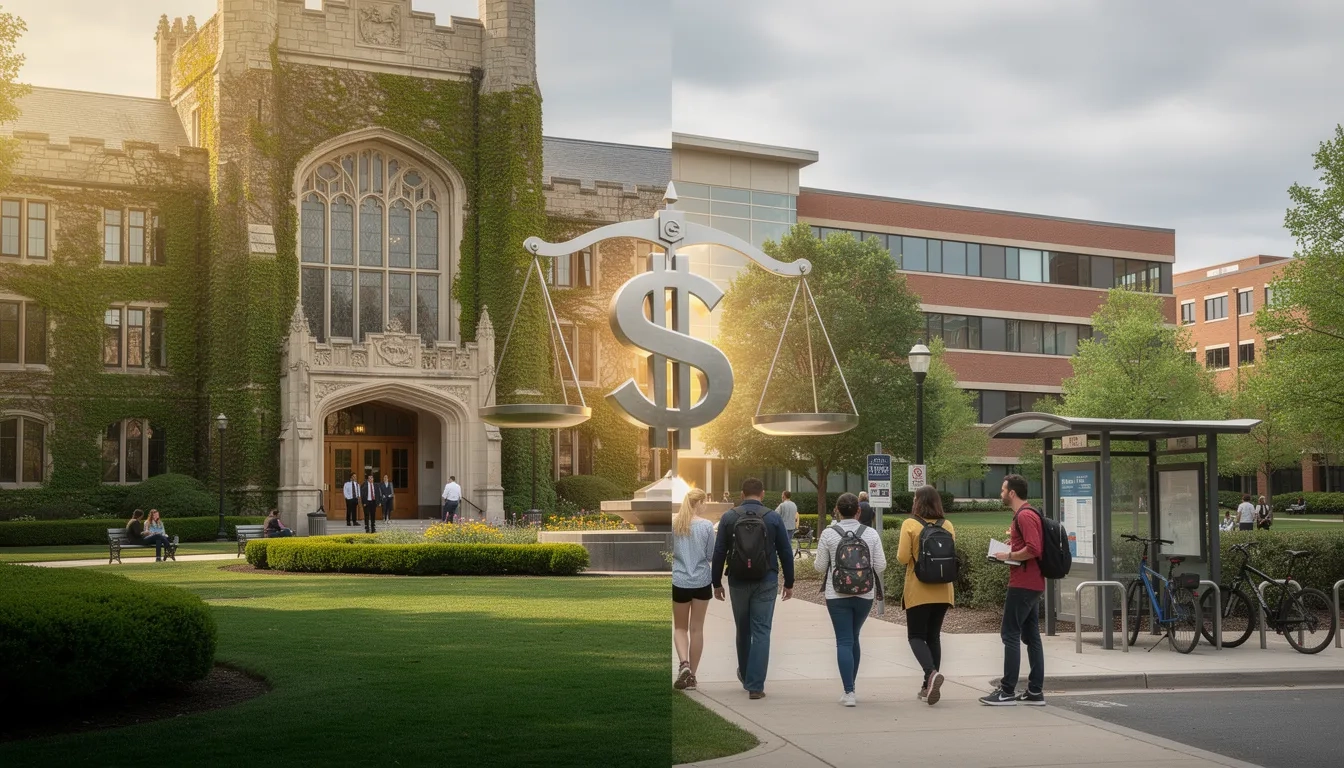
You got into your dream school. The acceptance letter is sitting on your kitchen table, the campus visit was electric, and the four-year sticker price is $287,000. Your state university acceptance came the same week — total cost over four years: $68,000. This is the largest financial decision most families make outside of buying a house. Most of them make it based on campus visit feelings and a list someone published in a magazine. The math gets done much later, if at all.
The Dream School Was Invented
The concept of the dream school didn't spring from careful career analysis. It was built by U.S. News rankings, college marketing departments, and campus tours designed to make 17-year-olds fall in love with a zip code.
The emotional attachment forms before anyone runs the numbers. 82% of students and parents say affordability is "very" necessary when choosing a college, according to research from College Raptor. Yet the same families routinely select schools they can't comfortably afford, convinced the prestige will eventually pay off.
Elite institutions don't compete on price because they don't have to. Their popularity ensures a steady stream of full-pay applicants. A full-price seat at NYU is a fundamentally different financial transaction than a merit scholarship at a regional state school with strong employer pipelines.
And here's the part that rarely comes up at college fairs: the concept of the dream school collapses under scrutiny once you ask what it's actually supposed to deliver. Career outcomes? Networking? Personal growth? All of those are available at far less expensive institutions, depending on your field.
When Prestige Actually Pays Off
The data here is genuinely complicated, and the honest answer is: sometimes the name matters. A lot.
Research across 7,300 college graduates found that business majors from selective institutions earn 12% more than those from mid-tier schools and 18% more than graduates of less-selective colleges. For social science majors, the differential runs 11-14%. Those gaps compound over a career.
Mid-career earnings for Ivy League graduates reach $161,888 compared to $101,777 for those from other institutions, according to compensation analyses from multiple sources. Princeton and MIT graduates report average starting salaries above $95,000, against a national median near $56,000 (NACE's 2024 benchmarking data). Real numbers. Real advantage.
But the premium nearly vanishes for STEM majors. That same study found an engineering student attending the University of Pennsylvania versus Texas A&M would see less than $1,000 salary difference in starting pay, despite a $167,000 gap in tuition costs. Employers hiring engineers want to evaluate your skills. Where you developed them matters far less than whether you actually have them.
| Major Category | Prestige Salary Premium | Typical Verdict |
|---|---|---|
| Business | 12–18% above non-selective schools | Selective school often justifies modest cost gap |
| Social Sciences | 11–14% above non-selective schools | Depends on employer and geography |
| STEM | Minimal to none | Affordable option usually wins on net |
| Arts / Film | Prestige often worsens ROI | Field earnings rarely service heavy debt |
The economic research from Dale and Krueger at Princeton adds another wrinkle: when you control for student ambition (measured by which schools they applied to), the earnings premium from attending a more selective college nearly disappears for average students. Where the premium does hold — and holds strongly — is for students from lower-income families and underrepresented backgrounds, who gain access to professional networks they wouldn't otherwise have. If you're a first-generation college student choosing between a full-pay selective school and a scholarship at a solid state university, the calculus genuinely differs from that of someone whose family already has professional connections.
The Major Problem That Overshadows Everything
School name gets outsized attention in this conversation. The major you choose inside that school gets almost none. The research says that's backward.
What you study drives your return on investment far more than where you study it. The Foundation for Research on Equal Opportunity (FREOPP) analyzed ROI across thousands of programs and found that 23% of four-year college programs leave students financially worse off than if they hadn't enrolled at all.
The starkest example in the data: NYU's film program carries a negative $22,000 ROI despite the school's prestige and price tag. SUNY-New Paltz's comparable film program generates a positive $148,000 return. Same career path. Opposite financial outcomes. The difference wasn't prestige — it was the combination of cost and what the labor market pays people who graduate into that field.
Median ROI by major, per FREOPP's analysis:
- Engineering: $949,000
- Computer Science: $652,000
- Nursing: $619,000
- Economics: $549,000
- Fine Arts: negative
- Education: near zero to slightly positive
The pattern has almost nothing to do with school ranking. It's about whether your chosen career field generates enough income to offset what you spent getting there.
The Debt Math Nobody Runs Before Signing
Student loan debt regret has become one of the more predictable outcomes of the college selection process. A recent survey found 63% of borrowers already regret taking on student debt. About 30% say their education wasn't worth what they borrowed. The average balance now sits just over $44,000, and half of all borrowers report the debt forced them to contribute less to retirement savings.
Nobody models the monthly payment before they sign. Most 18-year-olds have never paid a utility bill in their lives. The borrowed amount feels abstract until it isn't.
Here's a grounding calculation: take your expected total debt load and divide it by 10. That's a rough monthly payment under a standard 10-year repayment plan. If your target career starts at $42,000/year (teaching, social work, much of the arts), you're looking at roughly $2,900/month after taxes. Borrow $120,000, and the payment is around $1,200/month. That's 41 cents of every dollar going to loan payments before rent, groceries, or a car. No school name makes that math work.
What Financial Aid Letters Actually Show You
Most families compare sticker prices. Sticker prices are close to meaningless. Two schools with very different list prices can have nearly identical net costs after grants and scholarships — and occasionally the prestigious school is actually the cheaper option.
When your financial aid offers arrive, you want to know four things:
- Net price (sticker price minus grants and scholarships — not loans)
- Whether merit aid renews each year, and under what GPA requirements
- The split between grants (money you keep) and loans (money you repay)
- The full four-year cost projection, not just year one
And here's something most families don't know: financial aid packages are negotiable. If your state school offered $18,000/year in merit aid and your dream school offered $9,000, you can call the dream school's financial aid office and ask them to compete. Bring the competing offer. Schools actively recruiting you have real incentive to close the gap. Students who begin this comparison in the spring of 11th grade — before application fees are paid and before campus tours generate emotional attachment — can evaluate aid policies with clearer heads.
One more thing worth knowing: elite universities often won't grant subject credit for AP or IB exams, instead awarding vague "elective units" that don't count toward your major. Many require a 4 or 5 on the exam (versus a 3 at most public universities) and cap transferable credits. That can quietly add a semester or a full year to your timeline, which adds cost in ways the financial aid letter never mentions.
A Framework for Making the Call
Stop asking "which school do I love more?" and start asking: what net cost makes sense given my specific career path?
A few decision rules that hold up across most situations:
- STEM majors: School name adds minimal salary premium. Pick the lower-cost option unless the dream school offers specific verifiable advantages — documented research programs, funded lab access, named industry partnerships — that the affordable school genuinely can't match.
- Business and finance majors: Alumni networks and recruiting pipelines do matter. A selective school can justify a meaningful cost premium here. But run the 1-to-1 rule first: try not to borrow more in total than your expected first-year salary.
- Arts, education, and social work: Earnings in these fields are meaningful but rarely service heavy debt loads comfortably. The expensive dream school almost never pencils out numerically. This isn't a judgment on the work — it's arithmetic.
FREOPP's data adds another angle most families overlook: schools where fewer than two-thirds of students graduate post a median ROI under $50,000. Schools where more than two-thirds finish post $367,000. A prestigious school with a 42% four-year graduation rate is a measurably worse bet than a regional school where 83% of students graduate on time.
The question isn't which school you love most. It's which school you'll still feel good about five years after graduation, when the loan statements have been arriving for a while.
The Elephant in the Room Nobody Mentions
I'll say plainly what most college advisors hedge: most students pick their dream school before they know enough about themselves to make that call wisely. At 17, the decision is driven by campus aesthetics, a college's marketing spend, and social comparison with classmates. The rational framework gets bolted on afterward, if at all.
The better definition of a dream school is one that sets you up to live the life you actually want. That means a school that:
- Gets you out in four years with a degree in a field you want to work in
- Leaves you with debt you can realistically service on your starting salary
- Has faculty who actually have time for undergraduates, not just names on a website
- Has documented career placement rates in your specific industry
Some affordable schools clear all four bars. Some expensive dream schools fail most of them. The goal isn't to go cheap for the sake of it. It's to make the largest financial decision of your family's life with real information rather than a campus tour hangover and a ranking someone published.
My read after looking at the data: for most students in most majors, the affordable option is the right call. Not because prestige doesn't matter, but because the conditions under which it actually pays off — specific fields, specific career tracks, low net cost after aid — apply to fewer students than the college marketing industry would like you to believe.
Bottom Line
- For STEM majors, school prestige adds almost nothing to starting salary but can add $100,000 or more in debt. Choose the affordable option unless a specific program feature genuinely justifies the gap.
- For business and social science majors, a selective school does carry a real earnings premium — run the net cost comparison and the 1-to-1 debt rule before committing.
- Always compare net prices, not sticker prices. Call the financial aid office and ask them to compete if offers differ significantly.
- The 1-to-1 rule: try not to borrow more in total than your expected first-year salary in your chosen field.
- The dream school worth attending is the one you're still grateful for at 30, not just the one with the most recognizable name on move-in day.
Frequently Asked Questions
Does going to a more selective school actually improve your job prospects?
It depends heavily on your field. For business and social science careers, selective schools do provide a real network and recruiting advantage. For STEM careers, employers care primarily about skills — research from a study of 7,300 graduates found virtually no earnings difference between selective and non-selective school engineering graduates. For arts and education, prestige rarely translates into higher pay.
How much student loan debt is too much?
A widely used rule of thumb: don't borrow more in total than your expected first-year salary. If entry-level roles in your field pay $52,000, keep total borrowing under $52,000. Going significantly beyond that ratio creates real monthly cash-flow problems that follow you for a decade.
Is the dream school worth it if I receive a large scholarship?
Yes — if the scholarship brings the net cost close to or below what you'd pay at an affordable school. The key word is net price. A dream school offering $35,000/year in grants on a $70,000/year school is a very different proposition than one offering $5,000 on the same price. Compare what you actually pay, not what's listed.
Can I transfer to my dream school after starting at a cheaper option?
Sometimes. Transfer admission is competitive at selective schools, and many won't accept credits the same way they'd grant them to incoming freshmen. Elite universities are especially likely to cap transferred credits or require you to retake courses. Transfer is a viable path, but go in knowing it's not a guaranteed bridge.
What's the biggest mistake families make when comparing schools?
Comparing sticker prices instead of net prices. The listed tuition at a private school can look terrifying, while the actual cost after merit aid ends up lower than the in-state school's total bill. Equally common: not asking whether merit scholarships renew each year, and discovering in sophomore year that a GPA requirement no longer applies to them.
Does the prestige premium matter more for first-generation college students?
Research from Dale and Krueger's landmark NBER study found that selective college attendance produces stronger earnings gains for students from lower-income families and underrepresented backgrounds than for students whose families already have professional networks. If you're a first-generation student with limited professional connections, a selective school's alumni network may be genuinely harder to replicate elsewhere.
Sources
- Does College Pay Off? A Comprehensive Return On Investment Analysis – FREOPP
- Does School Prestige Affect Earnings Potential? – Vault
- Estimating the Return to College Selectivity over the Career – NBER (Dale & Krueger)
- Break Free from the Dream School Myth – Achievable
- Is Your Pursuit of a Dream School Becoming a Nightmare? – ScholarshipOwl
- Student Loan Debt Survey – Givling