Michigan vs Michigan State: Big Ten Rivalry Breakdown
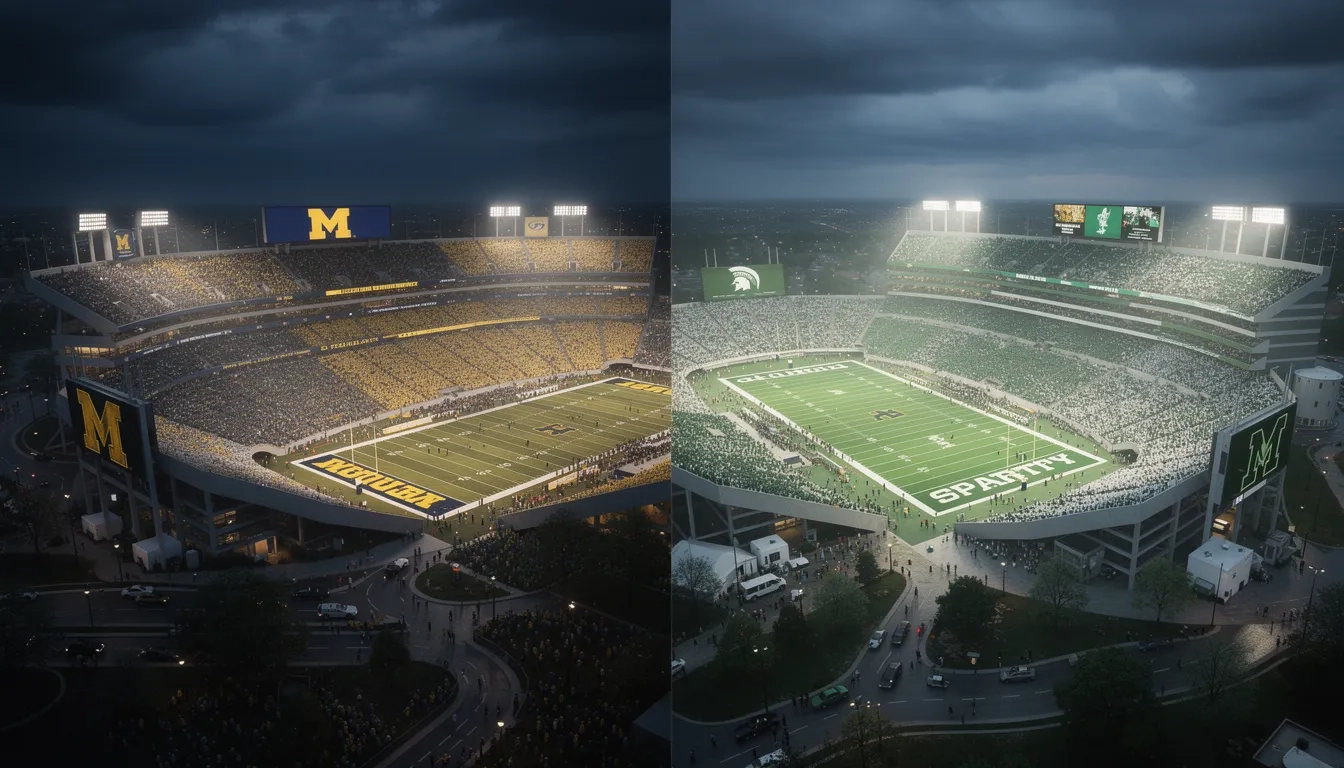
When Michigan running back Mike Hart called Michigan State his "little brother" during a 2007 postgame press conference, he probably thought it would land and be forgotten. Michigan State coach Mark Dantonio heard it. His players heard it. And then Michigan State won seven of the next eight games in the series. One throwaway comment reshaped a rivalry for a decade. That's the kind of thing that happens when two schools share a state, a conference, and over a century of genuine resentment.
How Two Schools Ended Up at Each Other's Throats
Michigan State wasn't founded to be Michigan's rival. It opened in 1855 as the Michigan Agricultural College — a land-grant school built to train farmers, foresters, and engineers. The University of Michigan, meanwhile, had been operating since 1817 and considered itself the state's academic flagship, full stop. There was always a status tension running underneath the athletic one.
MSU didn't even join the Big Ten until 1953. Before that, Michigan played against a school it didn't fully view as a peer. Joining the conference changed the dynamic immediately — suddenly the Spartans had a legitimate stage, shared schedules, and a reason to keep score. The first football game between the two programs happened on October 12, 1898. Michigan won 39–0. Nobody could have predicted what 127 years of follow-up would look like.
Football: The Battle for the Paul Bunyan Trophy
Michigan leads the all-time football series 75–38–5 across 118 games. That headline number flatters the Wolverines, though. Zoom into any given decade and the picture gets murkier.
The Paul Bunyan Trophy has been the official prize since 1953, when MSU joined the Big Ten. It's a four-foot wooden lumberjack statue that Lloyd Carr, Michigan's longtime coach, once called "the ugliest trophy in college football" — while quietly admitting he desperately missed it in years when his team didn't have it. The trophy series stands at Michigan 42–29–2.
Here's the more honest version of the rivalry, broken down by era:
| Era | Dominant Team | Key Detail |
|---|---|---|
| 1898–1952 | Michigan | Won 33 of first 50 games; largest win was 119–0 in 1902 |
| 1953–2007 | Mixed | Competitive; MSU had stretches under Duffy Daugherty and Biggie Munn |
| 2008–2015 | Michigan State | Won 7 of 8 after Dantonio's program took off |
| 2016–2019 | Michigan | Won 3 of 4 as Harbaugh rebuilt the Wolverines |
| 2020–2021 | Michigan State | Mel Tucker's back-to-back wins, including a stunning upset |
| 2022–2025 | Michigan | Won 4 straight, most recently 31–20 on Oct. 25, 2025 |
Neither team owns this rivalry for long. Power shifts, coaching staffs change, and the team caught on the wrong end of a streak eventually finds a way to fight back.
Games That Defined Eras
Some games live far past their final scores.
- 2001 Clockgate: Disputed timekeeping let Michigan State squeeze in a final-second field goal for a 26–24 win. The Big Ten changed its clock rules afterward.
- 2015 "Trouble with the Snap": A muffed punt snap with 10 seconds left let MSU return it for a touchdown. Michigan had the game won. Then it didn't. Michigan fans of a certain vintage can tell you exactly where they were watching.
- 2020 Halloween Upset: Michigan entered as 21.5-point favorites. Mel Tucker's Spartans won 27–24 in his very first season.
- 2023 Shutout: Michigan won 49–0 amid the ongoing NCAA sign-stealing scandal, which made the scoreboard feel both satisfying and complicated.
Basketball: Tom Izzo's Long Shadow
If football is where Michigan holds the historical edge, basketball has been a genuine back-and-forth — with one major caveat.
Michigan leads the all-time basketball series 99–92 (though 7 of those Michigan wins were vacated due to NCAA violations from the Ed Martin scandal era). Since MSU joined the Big Ten in 1950, the Spartans have actually won more games in the series than the Wolverines.
The reason is Tom Izzo. He took over at Michigan State in 1995 and never really left. Eight Big Ten titles. Nine Final Four appearances. He hit his 700th career win in January 2024. While Michigan's coaching staff has cycled through multiple regimes, Izzo simply stayed, recruited, and kept winning. That kind of institutional continuity is rare in college basketball.
But the rivalry has had genuine heat from both sides. On January 30, 2026, third-ranked Michigan beat seventh-ranked Michigan State 83–71 in Ann Arbor (the highest combined-ranking matchup in series history). Michigan has two straight wins heading into 2026-27. Both programs have won exactly 2 national championships each — Michigan in 1989 and 2021, Michigan State in 1979 and 2000.
The basketball rivalry is more balanced and more interesting than most people outside these two fanbases realize.
Academics: The Gap Is Real, But It's Not the Whole Story
Here's the thing many rivalry articles dance around. Academically, these two schools are not equals.
| Metric | University of Michigan | Michigan State |
|---|---|---|
| US News National Ranking (2026) | #20 | #64 |
| QS World Ranking (2026) | #45 | #161 |
| Acceptance Rate | 18% | 88% |
| In-State Tuition | $16,736 | $15,372 |
| Student-to-Faculty Ratio | 12:1 | 17:1 |
| Campus Size | 3,200 acres | 5,200 acres |
Michigan sits in the same tier as UCLA, UC Berkeley, and UVA. That's not hype — it's consistent across every major ranking system. MSU, by contrast, is a genuine R1 research university with $844 million in annual R&D spending, which is nothing to dismiss. Its supply chain management program has ranked number one nationally for years. Its programs in agriculture, education, and veterinary medicine are world-class.
The mistake is treating MSU as simply Michigan's lesser option. It's a different institution built on a different mission. But when a high-achieving Michigan high school student is choosing between the two, the selectivity gap matters. An 18% acceptance rate versus 88% means the two schools aren't drawing from the same applicant pool.
Campus Life: Ann Arbor vs. East Lansing
The schools feel different in ways that go well beyond football.
Ann Arbor is a real city — 120,000+ residents, a dense downtown with independent restaurants, music venues, and more than a few excellent bookstores. Michigan Stadium (nicknamed "The Big House," capacity 107,601) sits within walking distance of coffee shops and law school classrooms. The university and city are genuinely intertwined.
East Lansing is smaller and more classically campus-in-a-bubble in feel. The Michigan State campus is enormous at 5,200 acres, tree-lined and beautiful in a way that surprises first-time visitors. Spartan Stadium holds around 75,005 fans. The experience is more self-contained, more traditionally residential.
Both are good. They attract different students. Michigan pulls more out-of-state enrollment and carries a reputation for academic pressure. MSU has a more accessible social culture and a stronger on-campus community for students who want the full Big Ten residential experience. Neither is wrong — they're just different bets on what you want from four years.
The "Little Brother" Debate, Settled (Mostly)
Mike Hart's comment worked, unintentionally, as a perfect mirror of how Michigan fans actually think about this rivalry. For many Wolverine fans, the real rivalry is with Ohio State. Michigan State is the game you're supposed to win on the way there.
Michigan State fans understand that framing completely. They reject it furiously. And that rejection is the engine that makes this rivalry burn. Spartans fans don't want mutual respect from Michigan fans. They want to beat them. Repeatedly.
From a purely competitive standpoint, the "little brother" dynamic has been good for the series. Teams fighting to prove something tend to play harder in rivalry games. It explains how Dantonio's Spartans outperformed their talent level against Michigan year after year.
The honest take, though: this isn't a rivalry between institutional equals. It's a rivalry between the state flagship and a land-grant university that has built enough athletic credibility to make the games unpredictable and genuinely high-stakes. That's its own kind of interesting, and arguably more watchable than two programs that consider themselves exactly equal.
What Else Gets Decided Between These Two
The football and basketball storylines get most of the coverage, but the rivalry extends across the full athletic calendar. Michigan State has been competitive in wrestling, hockey, and women's basketball across various eras. The Big Ten's 2024 elimination of divisions could have put this rivalry at risk, but the conference explicitly guaranteed it under the new "Flex Protect Model" — a list of 11 protected rivalry games too commercially and culturally significant to leave to chance. The next game is November 7, 2026, in Ann Arbor.
That protection tells you something. Administrators don't fight to preserve games they don't need. This one, with 127 years of history and a genuinely complicated identity story behind it, isn't going anywhere.
Bottom Line
- Michigan leads football 75–38–5, but the series has never stayed one-sided for more than a decade. Michigan has the current momentum with four straight wins, including a 31–20 result on October 25, 2025, but Spartan programs have a history of finding counterpunches.
- Basketball is tighter than the football narrative suggests. Both schools have 2 national championships. Izzo's run at MSU has been dominant, but Michigan's recent wins — including an 83–71 victory over #7 MSU in January 2026 — show the Wolverines are competing at the same level again.
- The academic gap is real and significant. Michigan's global rankings and 18% acceptance rate put it in a different tier. But MSU runs nationally elite programs in several fields and shouldn't be written off as a consolation choice.
- The rivalry is best understood as a status asymmetry made competitive by athletic parity. Michigan's prestige makes wins meaningful to MSU fans. MSU's persistence makes losses costly for Michigan fans. That tension is what keeps 107,601 people showing up to a mid-October football game year after year.
Frequently Asked Questions
Who leads the all-time series in Michigan vs. Michigan State football?
Michigan leads 75–38–5 through 118 total meetings dating back to 1898. In the Paul Bunyan Trophy series (awarded since 1953), Michigan leads 42–29–2. Michigan has won four consecutive games from 2022 to 2025, the most recent a 31–20 victory on October 25, 2025.
Is the "little brother" comment the most important moment in this rivalry's modern history?
It's a strong argument. Mike Hart's 2007 postgame comment triggered Mark Dantonio's "pride comes before the fall" response and directly fueled Michigan State's run of seven wins in eight games from 2008 to 2015. Few pieces of trash talk have had that concrete and measurable an impact on a rivalry's competitive arc.
Is Michigan academically better than Michigan State?
By the major rankings, yes, and by a significant margin. Michigan ranks 20th nationally per US News and 45th globally per QS (2026). Michigan State ranks 64th nationally and 161st globally. The acceptance rate difference — 18% vs. 88% — is the starkest single number. That said, MSU has nationally top-ranked programs in supply chain management, agricultural sciences, and education that stand on their own merits.
What is the Paul Bunyan Trophy and why does it matter?
It's a four-foot wooden lumberjack statue awarded to the winner of the annual football game since MSU joined the Big Ten in 1953. Lloyd Carr once called it "the ugliest trophy in college football," which only added to its folklore. It's less glamorous than trophies like the Floyd of Rosedale or the Little Brown Jug, but both fanbases track who has it obsessively during the offseason.
Which school has a better basketball program historically?
Michigan leads the all-time series 99–92, but Michigan State has been dominant in recent decades under Tom Izzo. Both programs have won 2 national championships. Izzo's record — 8 Big Ten titles, 9 Final Four appearances, 700+ wins — makes him the defining figure of the basketball rivalry. Michigan's recent results, including a top-3 vs. top-7 win in January 2026, suggest the gap is closing.
What's the difference between living in Ann Arbor vs. East Lansing as a student?
Ann Arbor is a functioning city with 120,000+ residents, a real downtown, and a university embedded in an urban environment. East Lansing is smaller, quieter, and more campus-centric — Michigan State's 5,200-acre grounds practically function as their own ecosystem. Ann Arbor suits students who want urban energy and off-campus life; East Lansing suits students who want the full immersive campus experience without many distractions pulling them away.