How Transfer Admission Differs From Freshman Admission
Most students assume transferring is the backup plan made easy. Apply to a safety school as a freshman, spend a year there, build a decent GPA, then move up to the school you really wanted. Clean and simple. But here's the thing: Fairfield University accepts 33% of freshman applicants and just 7% of transfer applicants. That is not a typo. The process isn't just "freshman admission but later." It's a different game with different rules, and knowing which rules changed is the whole point.
What Admissions Officers Actually Evaluate
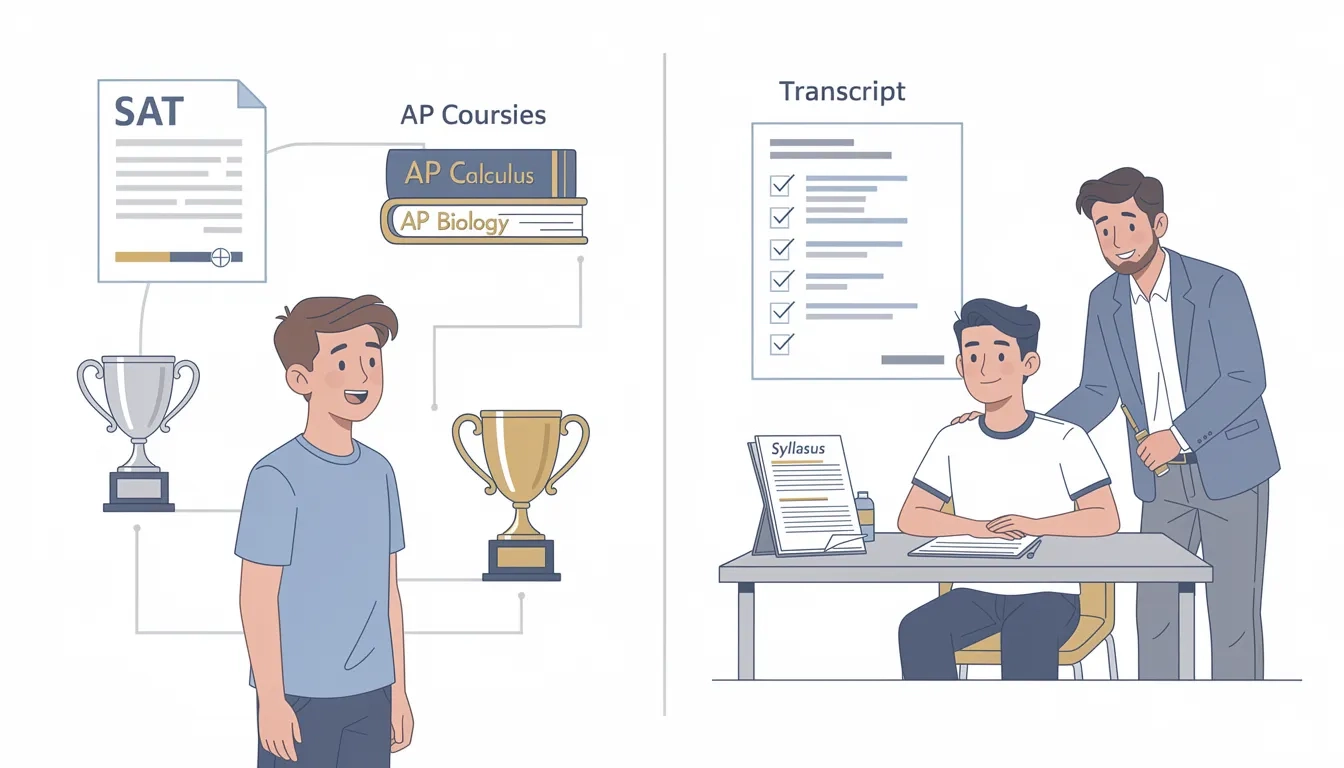
Freshman applicants are assessed on potential. High school GPA, course rigor (AP, IB, dual enrollment), SAT/ACT scores where required, extracurriculars, awards — all of it is evidence pointing toward one question: does this student look likely to succeed in college?
Transfer applicants flip this. You've already been in college. That's evidence, not projection.
Your college transcript becomes the dominant factor. Not your high school record. Not standardized test scores. Your performance in actual college courses — the rigor you chose, how you handled the transition, whether your grades trended upward. A student who coasted to a 3.2 in entry-level electives reads very differently than one who took upper-division prerequisites in their intended major and earned a 3.7.
High school records don't disappear. Admissions offices still pull them, especially at selective schools. The question shifts though — from "will this student thrive here?" to "would we have admitted this person as a freshman, and what have they done since?" It's a before-and-after comparison, not just a snapshot.
Here's a comparison of how the two pools are evaluated:
| Application Element | Freshman Applicant | Transfer Applicant |
|---|---|---|
| Primary academic record | High school transcript + GPA | College transcript + GPA |
| Test scores (SAT/ACT) | Often required or optional | Usually waived with 30+ college credits |
| Essays | Multiple prompts: personal statement + supplementals | Focused: "why transfer?" and "why this school?" |
| Recommendations | High school teachers + counselor | College professors, ideally in intended major |
| Application platform | Common App or Coalition (standardized) | Varies: Common App or school-specific portal |
| Deadline pattern | Predictable Nov/Jan rhythm | Wide range: February through June |
| Core evaluative question | Does this student have potential? | Has this student demonstrated success? |
Course selection matters for transfers in a way it doesn't for freshmen. Targeting an engineering program? You should be taking calculus and physics. Planning to major in business? Economics and accounting coursework signals you understand what you're walking into.
The Essay Is an Argument, Not a Story
Freshman applications reward self-expression. The Common App personal statement, supplemental short answers, activity descriptions — together they paint a portrait of who you are and what shaped you.
Transfer essays are narrower. And in some ways harder.
The central question is almost always the same: why do you want to transfer, and why this school? Some applications break it into two prompts. Others collapse it into one. Either way, you're making a case, not telling a story.
This is where many transfer applicants stumble. They write something like "I'm looking for a more challenging academic environment." That sentence explains nothing. The essay needs to answer: what is specifically limited or misaligned about where you are now? And what is specifically available where you're going?
The "why transfer" portion requires honest self-reckoning. A student who enrolled as a nursing major, discovered a passion for environmental policy, and now wants access to a program their current school doesn't offer — that's a compelling reason. "I just want something better" is not.
The "why us" portion has to go beyond campus tours and rankings. Not "I love your community" but something like: "The dual-degree program between Environmental Studies and Public Policy isn't available at my current institution, and Professor Katharine Anderson's work on urban food systems aligns directly with my senior thesis direction." Specificity is everything.
Paradoxically, the shorter essay requirement doesn't make transfer essays easier. There's less room to show personality. You're essentially making a business case for yourself, which requires self-awareness most 19-year-olds are still developing.
Who Writes Your Recommendations
This one catches students off guard.
Freshman applicants need letters from high school teachers and counselors — people who observed them over years and can speak to character, academic engagement, and growth.
Transfer applicants need letters from college professors. Ideally in or adjacent to the intended major. Ideally from professors who actually know you — not someone who vaguely recognizes your face from a 200-person lecture hall.
A letter that says "this student received an A in my class" is nearly useless. A letter that says "this student came to office hours regularly, challenged the assigned readings in ways that surprised me, and wrote a final paper I've referenced in my own work" — that is a recommendation.
If you're thinking about transferring at all, start attending office hours from week one. Not as a strategy, but because that's how you build the kind of relationship that generates a letter worth reading. Nobody builds those connections at month eleven when they're scrambling to submit a March 1 application.
Acceptance Rates Don't Follow the Pattern You'd Expect
Transfer acceptance rates are volatile. Much more so than freshman rates.
Dartmouth's transfer acceptance rate has swung from 1.5% to 29% in recent years depending on institutional priorities and how many enrolled students left. Harvard, Stanford, Yale, and Princeton all keep transfer acceptance below 2% — essentially the same odds freshmen face, with a smaller applicant pool.
At the same time, Boston University accepts 35% of transfer applicants versus 11% of freshmen. Several UC campuses actively recruit transfer students, with articulation agreements that create structured pathways from California's community college system. That kind of guaranteed access simply doesn't exist for freshman applicants.
The core reason rates swing so much: transfer slots are reactive. They depend on how many current students withdraw or don't return. Freshman class sizes are planned years in advance. Transfer class sizes are assembled to fill gaps that weren't predictable 18 months earlier.
This unpredictability makes building a college list genuinely harder for transfers. A school that's a reliable match-level admit for a freshman might be a coin flip for a transfer applicant in any given year.
- Transfer-friendly schools often include: UC schools, many large state flagships, Boston University, several Jesuit institutions
- Selective privates with notoriously low transfer rates: Harvard, MIT, Dartmouth, most highly-ranked liberal arts colleges
- Transfer rates at flagship state schools are generally more stable than at selective privates
Deadlines, Platforms, and the Logistics Gap
Freshman application deadlines are predictable. Early Decision and Early Action in November. Regular Decision in January. The specific dates differ by school, but the rhythm is consistent enough to plan around.
Transfer deadlines are all over the map.
Most schools target March 1 for fall enrollment, but some use February 1, others April 1, and rolling admissions schools may stay open through June. Spring transfers (where they exist at all) have fall deadlines around October or November — and spring openings are scarce because admissions offices are simultaneously processing freshman applications, so staffing and bandwidth are both stretched.
Application platforms are less standardized too. The Common App handles many transfer applications, but a significant number of schools use proprietary portals with different questions, different document requirements, and different timelines. Unlike the freshman experience where you can fill out one Common App and distribute it broadly, transfer applicants often find themselves managing 4 or 5 completely different submission systems.
Test score rules also shift. Students with 30 or more transferable college credits frequently don't need to submit SAT or ACT scores regardless of a school's stated test policy. The test-optional question for transfers is shaped by how many credits you've earned, not just institutional preference.
The Hidden Variable Nobody Talks About
Colleges use transfer cycles to fill specific gaps. If the nursing program is short on students, nursing transfers get prioritized. If a team needs to maintain NCAA roster numbers, athletes move through differently. If the school wants more geographic diversity in the fall cohort, a student from an underrepresented region gets a closer look.
None of this is published. There's no way to search what a school needs in its transfer class for any given cycle. It changes annually based on factors entirely outside your control.
Freshman admission has institutional priorities too — legacy status, recruited athletes, development cases — but the stakes per individual admit decision are different when you're filling a class of 40 transfer students versus 1,500 freshmen.
The practical takeaway: apply to more schools than feels comfortable. A student with a 3.8 GPA targeting nursing programs might get rejected from every school that offers one — not because they're underqualified, but because those programs had no open seats. This isn't a reflection of the applicant. It's a numbers problem with no clean solution except breadth.
Credit Transfer and Articulation Agreements
This dimension doesn't exist for freshman applicants at all.
Transfer students have to think about whether their coursework will actually count. Most schools require a grade of C or better (not C-minus — an actual C) for a course to transfer. Courses that are too specialized or don't map to the new institution's curriculum often transfer as free electives that do nothing for your major requirements.
The math can get ugly. A student who spent two years accumulating credits that don't transfer cleanly might effectively restart as a sophomore or freshman at their new school, paying four-year tuition while getting credit for maybe half of what they did.
Community college students transferring to four-year schools often benefit from articulation agreements — formal arrangements between institutions specifying exactly which courses transfer and how. California's system is the most developed: students at any of the 116 California Community Colleges can use ASSIST.org to see precisely which courses satisfy requirements at which UC or CSU campus. The IGETC (Intersegmental General Education Transfer Curriculum) allows students to complete a standardized set of general education courses that transfers intact to any UC campus, assuming grades of C or better throughout. Students enrolling after fall 2025 will use the newer Cal-GETC pattern, but the principle is the same.
Private universities are more variable. Some have bilateral agreements with specific feeder community colleges; most don't. Request a credit evaluation before committing, not after.
Bottom Line
Transfer admission rewards different things than freshman admission does. Here's what that means in practice:
- Your college GPA is the single most important factor. Not test scores, not potential, not what you did in high school three years ago. Perform well in challenging, relevant courses.
- Build professor relationships early, even before you decide to transfer. The quality of your recommendations depends entirely on whether professors actually know you.
- Research each school individually. Deadlines, document requirements, credit policies, and acceptance rates vary more than anything in the freshman application process.
- Apply broadly. Institutional need is unpredictable. Strong applications still get rejected for reasons that have nothing to do with the applicant.
- For community college students especially: find your articulation agreements before choosing courses. Taking the right classes in year one saves money and time that can't be recovered later.
The transfer path is legitimate, sometimes more accessible, and worth pursuing with real intention. But it is not a backdoor. It's a different door — with different locks.
Frequently Asked Questions
Does my GPA reset when I transfer?
Yes, at most schools your cumulative GPA starts fresh at the new institution. Your transfer GPA may appear on your official transcript for historical record, but it doesn't factor into your new school's GPA calculation. The reset can be motivating, but it also means your college GPA before you transfer is the only GPA admissions officers will ever see from you.
Is transferring to an Ivy League school easier than getting in as a freshman?
No — and at several Ivies, it's actually harder. Harvard's transfer acceptance rate runs below 1%. Princeton went years accepting zero transfer applicants. The applicant pool is smaller, but the number of available seats is also dramatically smaller. Unless there are genuinely compelling circumstances that have changed your academic trajectory since high school, elite transfers are not a reliable second chance at admission.
Do transfer applicants need to submit SAT or ACT scores?
It depends on how many college credits you've completed. Many schools waive standardized test requirements for students with 30 or more transferable credit hours. Applicants with fewer than 30 credits — roughly one year of full-time college — may still face test requirements. Check each school's specific transfer policy, since it often differs from the freshman test-optional policy at the same institution.
What makes a transfer essay stand out?
Specificity. The essay needs to name what you can't get at your current school (a program, a faculty member's research, a dual-degree option, a resource) and explain why that specific thing matters to your academic goals. Generic statements about wanting "better opportunities" are the most common weakness in transfer essays. Admissions readers see hundreds of them.
Is transferring from a community college to a four-year university a smart financial move?
For many students, yes — it's one of the most cost-effective paths through higher education. The tuition difference between two years at a community college and two years at a four-year institution can exceed $30,000 for in-state students, even before factoring in room and board. Students who research articulation agreements in advance and take the right courses can access highly selective four-year programs (including UC Berkeley and UCLA) at a fraction of the cost of enrolling as a freshman.
My application was rejected as a freshman. Does reapplying as a transfer make sense?
It depends. Sarah Harberson, a former admissions officer, notes that re-applicants face a specific question in the read: "Would we have admitted this student initially, and have they demonstrated meaningful growth since then?" If your application shows significant academic improvement, a clear reason for the change in direction, and specific alignment with the school's programs, reapplication can work. If your profile is essentially unchanged, the answer will likely be the same.
Sources
- Transfer Admissions: How Transfer Applications Are Evaluated – IvyWise
- 5 Secrets About Transfer Admissions From a Former Admissions Officer – Sarah Harberson
- Freshman vs Transfer College Applications – CollegeXpress
- How to Transfer Colleges – College Transitions
- Difference Between Transfer and Freshman Admission Rates – AP Guru
- The Transfer Student Application: Key Differences from First-Year Apps – Cirkled In